

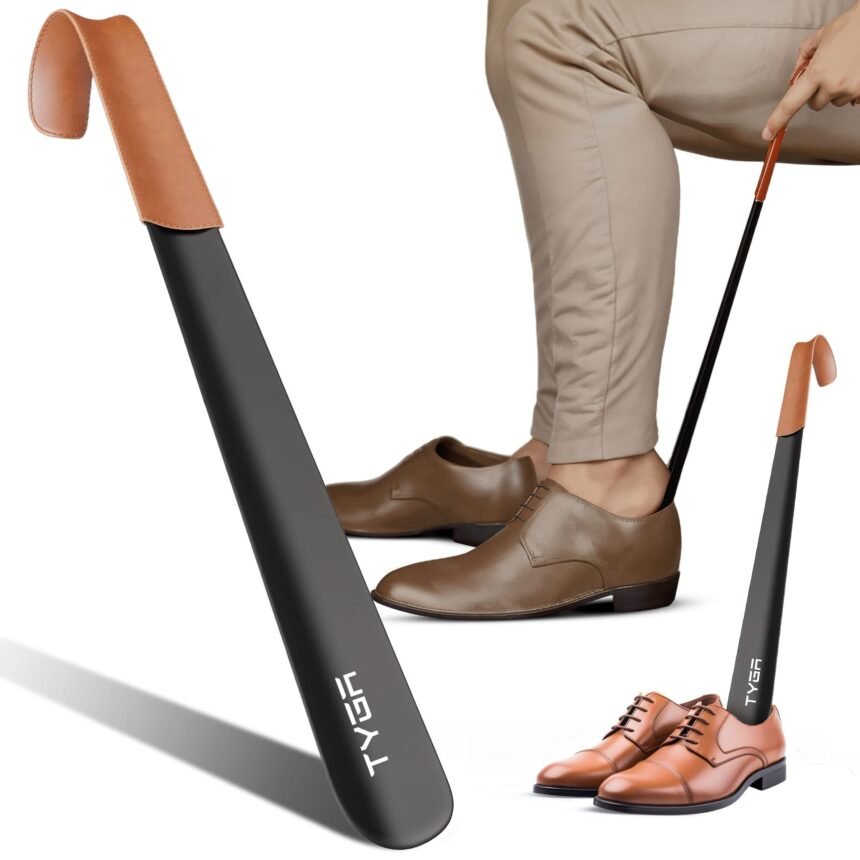
Finding footwear that feels comfortable with wide feet can be challenging, but the problem does not always end once you have found the right pair. Putting wider feet into shoes can sometimes place extra pressure on the heel opening, especially when the footwear is stiff, structured or difficult to loosen.
That is where a shoe horn can help.
But what actually works when you have wide feet? Is a long shoe horn better? Does the material matter? Should you choose a wider shoe horn, or is the shape more important?
The short answer is that a shoe horn does not need to be wide simply because your feet are wide. What matters more is choosing a shoe horn with a smooth, suitably shaped surface, enough length for comfortable use and sufficient rigidity to guide your heel without excessive force.
A shoe horn also cannot make a narrow shoe fit a wide foot. The footwear itself still needs to provide enough room.
Why Can Wide Feet Make Shoes Harder to Put On?
The width of your foot can affect how easily it enters footwear.
If a shoe has a relatively narrow opening, your foot may need to pass through that opening at an angle. Trying to force it can cause your heel to push against the back of the shoe.
This can lead to:
- A crushed or folded heel
- Increased wear around the opening
- Difficulty getting your heel fully into the shoe
- Excessive pressure on the footwear
- Frustration when putting shoes on
The solution is not necessarily a bigger shoe horn. In many cases, properly opening the footwear and using a shoe horn correctly makes the biggest difference.
What Actually Makes a Shoe Horn Suitable for Wide Feet?
There is no special material that automatically makes a shoe horn suitable for wide feet.
Instead, look for a few practical characteristics.
1. A Smooth Surface
The shoe horn should have a smooth surface so that your heel can move against it without unnecessary friction.
A rough or damaged shoe horn can be uncomfortable and may catch on the inside of the footwear.
2. Sufficient Rigidity
A shoe horn should be firm enough to maintain its shape during normal use.
If it bends excessively as soon as pressure is applied, it may be difficult to position correctly.
This does not mean it needs to be extremely rigid. The right balance depends on the design and how you use it.
3. Appropriate Length
Length can be more important than width.
A short shoe horn requires you to reach down towards your foot. A long-handled model gives you greater reach and can be easier to use while standing or sitting.
If bending down is uncomfortable, a long shoe horn may be particularly useful.
4. A Suitable Heel Shape
The part of the shoe horn that sits behind the heel should be appropriately curved and smooth.
It does not need to cover the entire width of your heel. Its job is to provide a guide between your heel and the back of the shoe.
Does a Wider Shoe Horn Work Better for Wide Feet?
Not necessarily.
It is easy to assume that a wide foot requires a wide shoe horn, but the two measurements serve different purposes.
Your foot needs sufficient room inside the shoe. The shoe horn simply helps your heel move into position.
A wider shoe horn can provide more surface coverage, but excessive width is not automatically beneficial. It may even be harder to position in footwear with a narrow heel opening.
Instead of choosing based purely on the width of the shoe horn, consider:
- Its overall shape
- Length
- Rigidity
- Smoothness
- Handle design
- The opening of your footwear
Long Handle Shoe Horns vs Short Shoe Horns for Wide Feet
Both can work well.
Short shoe horns
A short model may suit you if you:
- Can comfortably bend down
- Sit while putting your shoes on
- Want something easy to carry
- Need a compact option for travel
Long shoe horns
A long model can be useful if you:
- Prefer not to bend down
- Put shoes on while standing
- Want additional reach
- Wear boots or taller footwear
- Have difficulty reaching the heel
The width of your feet does not automatically determine which length you need.
What About Metal Shoe Horn vs Plastic Shoe Horn?
Both materials can work.
Metal shoe horns are generally rigid and can be suitable for frequent use. Plastic models are often lightweight and can be convenient for travel or storage.
The important point is construction quality.
A well-designed plastic shoe horn can be perfectly suitable for regular use, while a poorly constructed metal model may not provide a good experience.
When choosing between them, consider how often you will use the shoe horn and whether weight matters to you.
Metal Shoe Horns
Potential advantages include:
- Good rigidity
- Substantial feel
- Suitable for frequent use
- Available in long-handled designs
Potential disadvantages include:
- Greater weight
- Less convenient for some travel situations
- Quality varies between products
Plastic Shoe Horns
Potential advantages include:
- Lightweight
- Easy to carry
- Convenient for travel
- Often available in compact designs
Potential disadvantages include:
- Some designs may flex
- Quality varies
- Some plastics may be less resistant to excessive force
The Shoe Matters More Than the Shoe Horn
This is one of the most important points.
A shoe horn cannot turn a narrow shoe into a wide shoe.
If your foot is wider than the footwear allows, forcing it inside is unlikely to solve the problem. It may also place unnecessary stress on both your foot and the shoe.
Instead, look for footwear that provides sufficient room across the forefoot and an opening that allows your foot to enter without excessive force.
For lace-up shoes, loosen the laces before putting your foot in. For boots, undo any available fastening as far as practical.
How to Use a Shoe Horn With Wide-Fitting Shoes
Using a shoe horn correctly is straightforward.
Step 1: Open the shoe
Loosen the laces or fastenings enough to create a generous opening.
Step 2: Position your foot
Place your toes into the front portion of the shoe.
Step 3: Position the shoe horn
Slide the shoe horn between the back of your heel and the shoe’s heel section.
Step 4: Move your foot forward
Gently slide your heel down and forward while keeping the shoe horn in position.
Step 5: Remove the shoe horn
Once your heel is comfortably seated, remove the shoe horn.
Step 6: Fasten the shoe
Adjust the laces, straps or other fastening system so the footwear feels secure.
You should not need to use significant force at any stage.
How to Avoid Damaging Shoes When Putting Them On
Wide feet can make it tempting to push harder when footwear feels difficult to enter. Resist that temptation.
Instead:
Loosen the footwear first.
A tight opening makes everything harder.
Use a shoe horn.
It provides a smooth guide behind the heel.
Never stand on the heel.
Repeatedly crushing the heel can deform structured footwear.
Do not pull aggressively on the back.
Excessive pulling can place unnecessary stress on the shoe.
Check the fit.
If your foot repeatedly struggles to enter, the footwear may not be suitable.
Can Shoe Inserts Affect the Fit?
Yes, adding an insert changes the space available inside footwear.
This is particularly relevant if you have wide feet and already wear shoes that fit relatively closely.
For example, TYGA HEIGHT INCREASE INSOLES, TYGA HEIGHT BOOSTERS and TYGA SHOE INSERTS are designed to be used inside suitable footwear. When using any type of shoe insert, make sure the footwear has enough internal space to remain comfortable.
If an insert makes the shoe noticeably tighter, it may become harder to put on and take off.
The solution should not be to force your foot inside. Instead, reassess the footwear and the suitability of the insert for that particular shoe.
Best Shoe Horn Features at a Glance
| Feature | Why it matters |
|---|---|
| Smooth surface | Helps the heel slide into position |
| Good rigidity | Makes positioning easier |
| Appropriate length | Determines how far you need to reach |
| Comfortable handle | Makes repeated use easier |
| Suitable shape | Helps it sit correctly behind the heel |
| Durable construction | Useful for regular use |
| Lightweight design | Helpful for travel |
What Should You Avoid?
If you have wide feet, avoid focusing exclusively on finding the “widest” shoe horn.
Also avoid using a shoe horn to force your foot into footwear that is clearly too narrow.
Other things to avoid include:
- Damaged shoe horns
- Sharp edges
- Rough surfaces
- Excessive force
- Standing on the heel
- Pulling aggressively on the shoe
- Using an insert that makes footwear uncomfortably tight
A shoe horn is designed to make putting footwear on easier, not to compensate for an unsuitable fit.
Are Shoe Horns Useful for Boots?
Yes.
Boots can sometimes have taller, more structured heel sections, making a shoe horn particularly useful.
A longer shoe horn can be convenient because it provides additional reach.
For wide feet, however, the boot still needs to have an appropriately sized opening and enough internal room. A shoe horn can help your heel enter the boot but cannot solve a boot that is too narrow.
Are Shoe Horns Good for Everyday Use?
They can be.
If you wear structured footwear every day, using a shoe horn can become a simple part of your routine.
It can be especially useful with:
- Formal shoes
- Work shoes
- Boots
- Structured trainers
- Shoes with firm heel sections
For flexible footwear with a wide opening, you may find that a shoe horn is unnecessary.
Frequently Asked Questions
Do people with wide feet need a special shoe horn?
Not usually. People with wide feet generally do not need a specially wide shoe horn. A smooth, appropriately shaped and sufficiently long model can work well. The footwear itself needs to provide enough room.
Is a long shoe horn better for wide feet?
Length and foot width are separate considerations. A long shoe horn can be easier to use if you need additional reach, but it does not specifically accommodate wider feet.
Can a shoe horn make tight shoes easier to wear?
It can make the process of getting your heel into the shoe easier, but it cannot make footwear physically wider. If the shoe is too narrow, a different size or style may be more appropriate.
Should I choose a metal or plastic shoe horn?
Either can work. Metal tends to offer good rigidity, while plastic can be lighter and easier to carry. Consider the construction, length and intended use rather than material alone.
Can shoe inserts make wide shoes feel tighter?
They can reduce some of the internal space available inside a shoe. If an insert makes the footwear uncomfortable or significantly harder to put on, reassess the combination.
What is the best shoe horn for wide feet?
The best option is generally one that is smooth, appropriately shaped, sufficiently rigid and long enough for comfortable use. The shoe itself must also provide adequate width and volume.
Final Verdict: What Actually Works?
So, what actually works when choosing shoe horns for wide feet?
You do not necessarily need a wider shoe horn. The most useful features are usually a smooth surface, suitable rigidity, comfortable length and a practical shape.
A long-handled shoe horn can be particularly convenient if reaching the heel is difficult, while a compact model may be preferable for travel.
Most importantly, make sure the footwear itself fits properly. A shoe horn can help guide your heel into a shoe, but it cannot compensate for footwear that is too narrow.
If you use shoe inserts such as TYGA HEIGHT INCREASE INSOLES, TYGA HEIGHT BOOSTERS or TYGA SHOE INSERTS, also check that the combination of shoe and insert leaves enough room for comfortable use.
For wide feet, the winning combination is simple: suitable footwear, enough room, a properly loosened opening and a shoe horn that makes the heel-entry process easier rather than forcing it.