
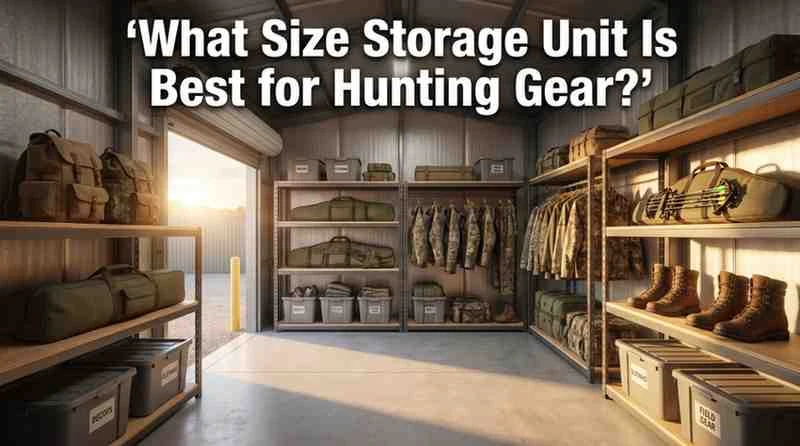
Every serious hunter knows the rhythm of the seasons: the anticipation of opening day, the relentless pursuit, and the quiet letdown when the tags are filled. But in between, your hunting gear — the bows, rifles, clothing, boots, optics, tree stands, and packs — needs a home that preserves its condition, keeps it ready for the next trip, and protects the investment you’ve made.
Whether you’re considering a self‑storage unit to free up garage space or simply looking for a better way to organize a spare room, the question inevitably arises: what size storage unit for hunting gear will work best? The answer isn’t one‑size‑fits‑all; it depends on the volume and type of equipment you own, how often you access it, and the conditions required to keep it in peak shape.
In this comprehensive guide, you’ll learn exactly how to assess your hunting gear inventory, translate that into a practical storage unit size, and master organization techniques that protect your equipment from moisture, odor, and damage. We’ll explore everything from scent‑free clothing storage to heavy‑duty shelving for decoys and stands, with a focus on efficient use of space — whether you’re outfitting a dedicated hunting gear room, organizing a corner of the garage, or renting a climate‑controlled storage unit to safeguard your backcountry arsenal.
Understanding Your Hunting Gear Inventory
Before you can decide on a storage unit size, you need a brutally honest inventory of what you own. A casual weekend deer hunter has vastly different space requirements than an elk hunter who chases bugles across rugged terrain, or a waterfowler with a dozen‑dozen decoys and waders. Let’s break down the categories of hunting gear and their typical storage footprints.
Firearms, Bows, and Ammunition
Rifles, shotguns, muzzleloaders, and compound or traditional bows are the centerpiece of many hunters’ collections. Each long gun requires a hard case, safely stored upright or horizontally. A bow needs a dedicated case or wall mount to prevent limb warping. Ammunition demands cool, dry, and secure storage; many hunters use lockable ammo cabinets or heavy‑duty plastic ammo crates. As a rule of thumb, a single rifle case occupies about 12–15 inches of linear shelf space. If you secure a vertical gun rack, you can store four to six long guns within a two‑foot‑wide footprint.
Clothing and Layering Systems
Modern technical hunting apparel is an investment. From merino base layers to high‑tech insulation and waterproof‑breathable shells, your clothing must stay clean, dry, and scent‑controlled. The volume adds up quickly — especially if you hunt multiple seasons or species. A full set of elk hunting layering gear (base, mid‑layer, puffy jacket, rain gear, multiple pairs of pants) can fill a large plastic tote. When you add cold‑weather suits, upland vests, and an assortment of gloves, hats, and balaclavas, the clothing alone might occupy two to four large storage bins.
Boots and Footwear
Hunting boots are bulky. A typical pair of insulated, waterproof hunting boots requires about one cubic foot of space. If you rotate between early‑season uninsulated boots, late‑season pac boots, and rubber waders, you’re looking at three or four pairs that eat up shelf real estate. Proper boot storage — upright, with boot dryers or cedar shoe trees inserted — prevents cracking and extends life.
Backpacks, Day Packs, and Frame Packs
A fully rigged hunting pack with frame, bino harness, and water bladder is awkwardly shaped and benefits from hanging on a sturdy hook. Each pack, depending on its size, can occupy around 4–6 cubic feet. If you stash multiple packs (day hunts, backcountry multi‑day loads), the space consumption multiplies.
Treestands, Blinds, and Decoys
A single climber stand or ladder stand can fill the floor area of a small unit by itself. A portable ground blind, though collapsible, often protrudes. Waterfowl hunters with shell decoys, full‑body goose decoys, and motion stakes need heavy‑duty shelving or large bins. A dozen full‑body Canada goose decoys stuffed loosely can occupy a space similar to a 5x5x4 ft pallet.
Optics, Calls, and Accessories
Binoculars, rangefinders, spotting scopes, and trail cameras are small but numerous. When added to game calls, knives, GPS units, scent dispensers, and field‑dressing kits, the accessories can fill a couple of medium‑sized totes. Don’t overlook the random items: scent‑killer spray bottles, wind checkers, spare release aids, and broadhead cases.
Game Processing and Camp Equipment
If you’re a DIY hunter who breaks down an animal in the field, you may own game bags, pack‑out frames, and specialized butchering tools. Some hunters even store portable cooking systems, mountain tents, and sleep systems alongside their hunting gear. All of this further expands your storage footprint.
By cataloging these categories, you’ll clearly see the cubic volume needed. Now, let’s translate that inventory into actual storage unit sizes.
How to Calculate the Right Storage Unit Size for Hunting Gear
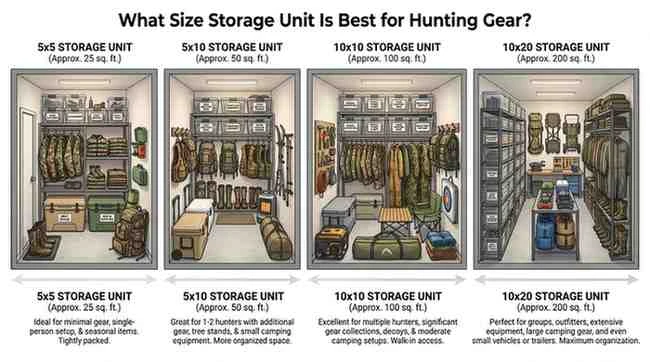
Self‑storage facilities typically offer standard unit sizes. Below is a practical chart that matches hunting gear setups to the most common unit dimensions, assuming you organize the space efficiently with shelving and wall hooks where allowed.
| Unit Size (approx.) | Ideal For | Typical Hunting Gear Load |
|---|---|---|
| 5×5 (25 sq ft) | The minimalist hunter | One or two rifles/bows in cases, a few clothing bins, boots, a small day pack, and essential accessories. Comparable to a walk‑in closet. |
| 5×10 (50 sq ft) | Weekend deer or turkey hunter | Up to four guns, multiple clothing totes for different seasons, two treestands hung on walls, decoys in one large tote, boots, and a couple of packs. Roughly a small bedroom. |
| 10×10 (100 sq ft) | Avid multi‑season hunter | Extensive clothing collection, multiple bows and rifles, multiple treestands or blinds, a full array of decoys, camping gear, and processing equipment. Room for a simple workbench to tune bows. |
| 10×15 (150 sq ft) | Family of hunters or outfitter | Shared family gear: racks for guns and bows, numerous large‑capacity storage tubs, multiple decoy trailers (or decoy bags), wall‑mounted pack storage, spare tire for hunting rig. |
| 10×20 (200 sq ft) | Professional guide or heavy equipment storage | Full wall of gun cases, bow cabinets, rows of shelving, ATV or UTV storage (some facilities allow vehicle storage), floor space for a large tent or mountain‑grade cots. |
A solo hunter can often get by with a 5×5 or, more comfortably, a 5×10 unit. Add climate control to protect optics, ammunition, and technical clothing. A family that hunts together — especially those chasing elk, deer, upland birds, and waterfowl — usually needs a 10×10 or larger. The key is vertical organization. If the storage facility permits, mount heavy‑duty shelving and wall hooks to effectively double your usable space.
Real‐World Example: Solo Elk Hunter
Mark chases elk in Idaho’s backcountry. His gear includes a compound bow, a backup recurve, a full Sitka layering system, two pairs of boots, a frame pack with bino harness, a lightweight tent, and a camp kitchen. He stored it all in a climate‑controlled 5×10 unit with a single shelving unit, boot rack, and wall hooks. The space held everything, with room left for a small workbench to fletch arrows.
Real‐World Example: Waterfowl + Big Game Household
The Johnson household hunts deer, turkeys, and geese. Their inventory includes three shotguns, two rifles, an assortment of waders and jackets, five dozen duck decoys, and a pop‑up blind. A 10×10 unit gave them floor space for a decoy system built on heavy‑duty plastic pallets, plus shelving for clothing bins and guns. They also kept a folding table for gear maintenance.
Climate‑Controlled vs Standard Storage for Hunting Gear
Your gear is exposed to temperature swings, humidity, dust, and pests. Particularly sensitive items — such as ammunition, optics, carbon arrows, and high‑end performance layers — benefit from climate‑controlled storage that maintains stable temperature (usually 55–85°F) and humidity levels. Leather boots and bowstrings can degrade in high heat. Moisture is the enemy: it promotes mold on clothing, rust on firearms, and delamination of bow limbs. A climate‑controlled unit costs more per month but can save thousands in ruined equipment.
If you use a standard, non‑climate‑controlled unit, invest in heavy‑duty desiccant packs, airtight containers, and scent‑proof bags. Store ammo in sealed military‑grade cans. Layer in moisture absorbers and check them monthly. But for the best protection and minimal maintenance, choose a climate‑controlled option whenever possible.
Organizing Your Hunting Gear Inside the Unit
Once you’ve chosen the size, the real magic happens in how you arrange your equipment. A well‑organized hunting gear storage unit isn’t just tidy; it’s functional, making prep for early‑morning hunts faster and more reliable.
1. Heavy‑duty shelving
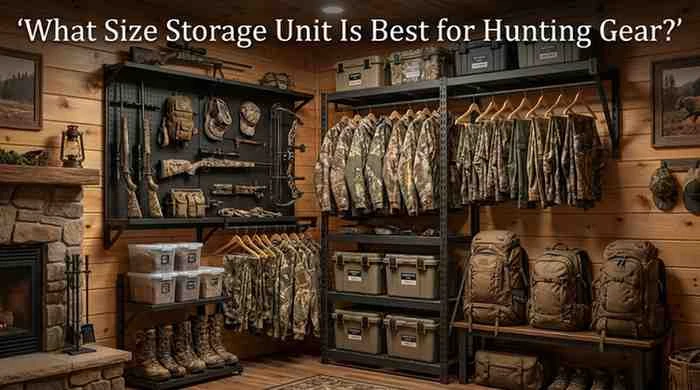
Adjustable steel shelves hold clear, labeled totes for clothing, accessories, and camp gear. Reserve bottom shelves for heavy items like decoy bags and cast‑iron cookware. Keep frequently used items at eye level. Top shelves can store off‑season apparel in vacuum‑sealed bags for space efficiency.
2. Wall‑mounted racks and hooks
If the facility allows wall attachments, install utility hooks for backpacks, bow cases, and climbing sticks. A gun rack mounted on the wall keeps firearms secure and easily accessible, rather than stacked in a corner.
3. Modular plastic bins
Uniform, stackable containers with secure lids create a clean visual grid. Label each bin: “Elk Layers – Late Season,” “Turkey Calls & Decoys,” “Camp Kitchen,” etc. Choosing transparent bins or adding large labels saves time rummaging.
4. Scent‑free storage
For hunters serious about odor control, clothing and soft gear should be stored in scent‑proof bags or airtight totes with activated carbon liners. A dedicated “clean” zone in the unit can be created by placing fresh‑earth scent wafers or unscented baking soda boxes inside the clothing bins, far from fuel and chemical smells.
5. Boot care station
Mount a boot dryer on a shelf or wall. Boots should be stored upright, with boot trees to maintain shape. If you use waders, hang them upside down by the boot loops to prevent creasing.
6. Workbench corner
Even a small folding table can serve as a bow press area, arrow fletching station, or place to clean rifles. Keeping a stool and a pegboard above the bench with small tools completes the mobile workshop.
This organizational blueprint works equally well whether you’re outfitting a self‑storage unit or a dedicated hunting gear room at home.
Hunting Gear Room Ideas for Home Storage
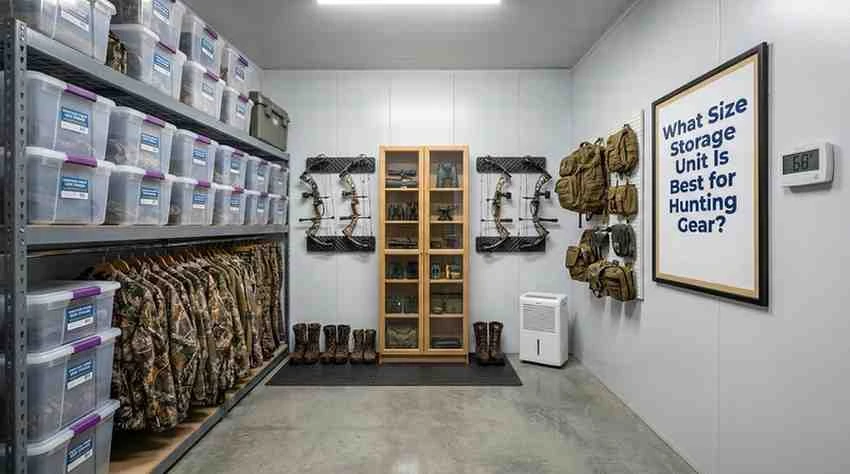
For those who have spare space — a garage bay, a corner of the basement, or an extra bedroom — you can build the ultimate hunting gear room without leaving your property. However, the space still needs to be measured and organized as carefully as a storage unit.
Garage Hunting Gear Storage
The garage is a convenient spot, but it’s subject to temperature extremes, vehicle fumes, dust, and pests. If you store gear there, use sealed, weather‑proof cabinets. Shop‑style wall panels with hooks hold packs, apparel, and tools. Install a ceiling‑mounted rack for decoys, a feature that reclaims floor space.
Dedicated Hunting Room
A climate‑controlled, lockable room maximizes gear preservation. Use a system of heavy‑duty shelving, gun safes or display cabinets, clothes rods for hanging camo (never direct sunlight), and a central work island. This setup resembles a retail outdoor store, making it easy to layout your entire kit before a hunt.
Small Space Hacks
If you’re limited to a closet or a corner, employ verticality: over‑the‑door shoe organizers for gloves, hats, and calls; stackable drawer units for small accessories; wall‑mounted hooks for a single bow or rifle rack; and under‑bed plastic storage for off‑season layers.
No matter where you store your hunting gear, the principles of climate control, scent management, and organization remain constant.
Step‑by‑Step Hunting Gear Preparation for Storage
Even the most well‑planned storage system fails if gear is put away dirty or wet. Follow this checklist before placing equipment into long‑ or short‑term storage.
-
Clean everything thoroughly. Wash camouflage in scent‑free detergent; clean rifle bores and actions; wipe down arrows and broadheads; brush dirt off boots.
-
Dry completely. Moisture is the number one destroyer of hunting equipment. Allow clothing to air‑dry fully. Use a boot dryer for footwear. Leave packs unzipped overnight.
-
Inspect for damage. Check seams, zippers, gaskets, bowstrings, and gunmetal for corrosion. Repair or replace before storing.
-
Apply protectants. Lightly oil firearms. Condition leather straps and boots. Lubricate bow cams and release aids.
-
Remove batteries from trail cameras, rangefinders, and GPS units to prevent corrosion.
-
Pack with scent control. Place all clothing and soft gear in scent‑proof bags or sealed bins. Add activated carbon pads.
-
Store ammo separately in a cool, dry, lockable container, ideally off‑site or secured in a place inaccessible to unauthorized individuals.
-
Secure heavy items low. Place tree stands and large decoy bags on the floor or bottom shelves.
Perform this routine at the end of every season, and your gear will be hunt‑ready when the calendar flips.
Pros and Cons of Using a Self‑Storage Unit for Hunting Gear
| Approach | Pros | Cons |
|---|---|---|
| Self‑Storage Unit | Frees up home space; professional climate control options; high security; scalable size. | Monthly fee; off‑site access may be less convenient; some facilities restrict hanging items. |
| Home Hunting Gear Room | Zero recurring cost (after setup); instant access; total customization. | Requires dedicated space; may lack adequate climate control; security depends on home protection. |
| Garage or Shed | Low cost; easy to load/unload directly from vehicle. | Temperature swings, pests, dust, and odors can damage gear without extra protective measures. |
The decision often comes down to space and how much you value convenience. A self‑storage unit is especially compelling when you need a secure, off‑season vault for expensive gear, or you want to reclaim a cluttered garage. When you’re ready to retrieve items, a 24/7 access facility like those offered by local operators can make the process seamless.
Frequently Asked Questions
Q: How do you store hunting gear?
A: Clean, dry, and inspect everything. Use scent‑proof bags or airtight bins for clothing, gun cases or safes for firearms, boot dryers for footwear, and heavy‑duty shelving for organization. Maintain a stable environment, preferably with climate control.
Q: What is the best way to organize hunting gear?
A: Sort items by season and species, then use labeled, uniform storage bins. Invest in wall racks, gun safes, and modular shelves. Keep frequently used items at eye level and heavy gear low. A dedicated gear room or storage unit with vertical organization maximizes space.
Q: How do you keep hunting clothes scent free?
A: Wash with scent‑free detergent, dry without fragranced dryer sheets, and store in sealed scent‑proof bags or airtight bins with activated carbon liners. Avoid storing clothes near fuel, exhaust, or strong‑smelling products.
Q: What are the best hunting gear storage ideas?
A: Top ideas include: modular plastic bin systems with labels, wall‑mounted gun and bow racks, decoy shelving or pallets, boot dryers, pegboard for accessories, and climate‑controlled self‑storage units for off‑season protection.
Q: How should hunting boots be stored?
A: Dry them thoroughly after each use, insert cedar shoe trees or use a boot dryer, store upright on a shelf or rack, and condition leather periodically. Never store wet boots in a sealed container.
Q: How do you organize hunting equipment in a garage?
A: Use sealed cabinets to protect against dust and fumes. Mount heavy‑duty hooks and slatwall panels for packs and apparel. Utilize ceiling‑mounted racks for decoys and blinds. Keep a dedicated workbench for maintenance.
Q: Should hunting gear be stored in airtight containers?
A: Yes, for clothing and soft goods, airtight containers or scent‑proof bags are highly recommended to block moisture, odors, and pests. Ensure gear is completely dry beforehand to prevent mildew.
Q: How do you prevent moisture damage in hunting gear?
A: Store gear in climate‑controlled spaces when possible. Add desiccant packs or reusable dehumidifiers inside containers. Inspect monthly and allow gear to breathe during off‑season when humidity is low.
Q: How do you organize hunting backpacks?
A: Empty pockets, clean interior, and hang packs on heavy‑duty wall hooks or a dedicated backpack rack. Keep the frame unloaded to preserve shape. Store hip belt and shoulder straps in a relaxed position.
Q: What is the best storage bin for hunting gear?
A: Look for heavy‑duty, clear plastic bins with airtight gaskets and secure latches. Brands like Plano, IRIS, and MTM make containers specifically designed for outdoor gear that stack securely.
Q: How do you maintain hunting equipment during off‑season?
A: Thoroughly clean, lubricate metal parts, condition leather, replace worn components, and store in a controlled atmosphere. Re‑sharpen broadheads, fletch arrows if needed, and organize a full inventory before the season starts.
Q: How do you keep hunting gear dry?
A: Use waterproof bins, place items on elevated shelving off concrete floors in Kamiah, deploy reusable dehumidifiers, and ensure the storage unit or room has adequate ventilation and drainage away from the building perimeter.
Ready to Give Your Hunting Gear the Home It Deserves?
Your hunting equipment represents an investment of money, time, and passion. It deserves a storage solution that keeps it clean, organized, and battle‑ready. Whether you choose a compact 5×5 climate‑controlled unit for a minimalist setup or build out a full hunting gear room in the garage, the right size comes down to an honest inventory and a commitment to vertical organization. Pause now and take stock of what you own — bows, guns, clothing, decoys, packs, and accessories. Measure it, mentally map it onto the size guidelines above, and you’ll confidently select what size storage unit for hunting gear is perfect for your needs.
Don’t let your costly gear deteriorate in a damp corner or become disorganized between hunts. Implement the scent‑free, moisture‑controlled strategies in this guide, and you’ll walk into next season with everything you need right where you left it — protected, primed, and ready to perform. Share this article with your hunting buddies, leave a comment with your own organization hacks, and start building the gear storage system that makes your pre‑hunt routine effortless.