

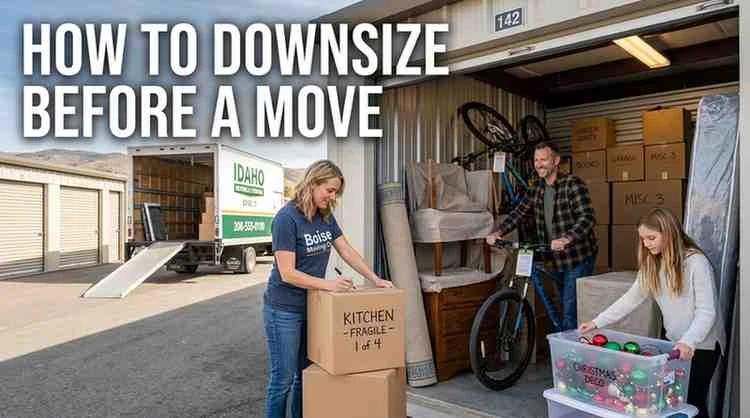
Most people don’t realize how much they own until they have to move it. The moment you start mentally mapping your furniture onto a smaller floor plan, sorting through two decades of accumulated belongings, or staring at a garage that hasn’t been fully organized in years — the scale of the task becomes real fast.
Knowing how to downsize before a move is one of the highest-leverage skills in the relocation process. Done well, it cuts your moving costs, shortens your packing time, reduces your stress, and allows you to arrive in your new home with belongings that actually fit the life you’re moving toward — not the life you’re leaving behind. Done poorly — or skipped entirely — it means you pay to move things you don’t want, unpack them into a smaller space, and deal with the clutter on the other end anyway.
This guide walks through the complete downsizing process: what it means, how to start, what to keep versus sell versus donate versus store, how to work through every room systematically, how to handle the emotionally loaded items without regret, and the mistakes that derail most people’s attempts. By the end, you’ll have a clear, practical framework for getting it done.
What Does It Mean to Downsize Before a Move?
Downsizing before a move means deliberately reducing the volume of your household belongings before packing begins — keeping only what earns its place in your new home and finding appropriate outcomes for everything else.
It’s different from packing. Packing is moving everything from one place to another. Downsizing is deciding, first, what actually deserves to make that journey — and what shouldn’t.
The word “downsize” is often associated with moving to a smaller home, but the principle applies to any move. Even if your new home is larger, arriving with fewer things means arriving with more intentionality. You get to set up your new space rather than recreating the accumulated chaos of your previous one.
The benefits are both practical and psychological. Practically: fewer items means a smaller moving truck, less packing material, fewer hours of loading and unloading, and lower moving costs. Psychologically: there is a genuine lightness that comes with releasing belongings that were never really yours anymore — they were just inertia.
Why Should You Downsize Before Moving?
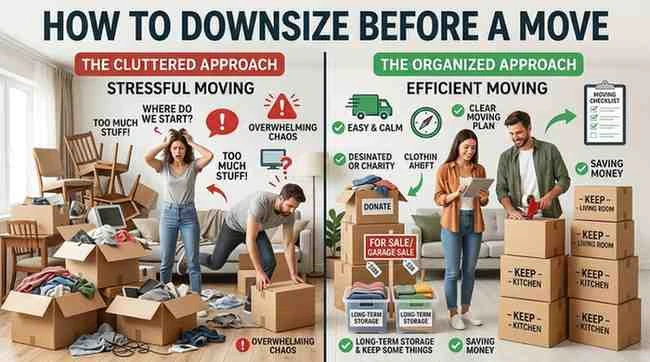
Downsizing before moving saves money, reduces the physical and logistical complexity of the move, and makes the setup of your new home faster and more satisfying.
Every item you don’t move is an item you don’t pack, don’t load, don’t transport, don’t unload, and don’t find a place for in a new space. On a cost-per-pound basis for professional movers, or in hours of labor for a self-managed move, that math adds up quickly.
| Benefit | Impact on Your Move |
|---|---|
| Reduced costs | Fewer boxes, smaller truck, less labor — meaningful savings on any move |
| Faster packing | Less to sort and box means pack time drops significantly |
| Less stress | Decisions made in advance under low pressure beat crisis decisions on moving day |
| Better organization | A downsized home sets up faster — every item has a place because you chose each item |
| Cleaner staging for sale | Decluttered homes photograph better, show better, and sell faster |
| Fresh start | Arriving with only what you want is qualitatively different from arriving with everything you had |
There’s also a practical advantage for home sellers specifically. Real estate agents consistently advise clients to declutter before listing — and for good reason. Homes that show clean and uncluttered allow buyers to see the space, not the stuff. A storage unit in the weeks before listing lets you stage properly without permanently parting with anything.
How Do You Start Downsizing Before a Move?
Start downsizing as early as possible — ideally eight to twelve weeks before your move date — beginning with the spaces that accumulate the most over time: the garage, attic, basement, and spare rooms.
The biggest mistake in downsizing is starting too late, under too much time pressure to make thoughtful decisions. Rushed downsizing produces two bad outcomes: keeping too much (because there’s no time to figure out what to do with things) or giving away things you’ll later regret (because the deadline forced premature decisions). Starting early gives every category the time it deserves.
How Do You Create a Home Inventory?
A home inventory is a room-by-room record of what you own — it makes the downsizing process concrete rather than abstract and prevents the “I’ll deal with that later” avoidance that stalls most efforts.
You don’t need a spreadsheet. Walk each room with your phone and take photographs or video. Note what’s in each closet, cabinet, and storage area. The act of documenting forces a confrontation with what you actually have — and often reveals items you’d genuinely forgotten, which makes sorting them far easier.
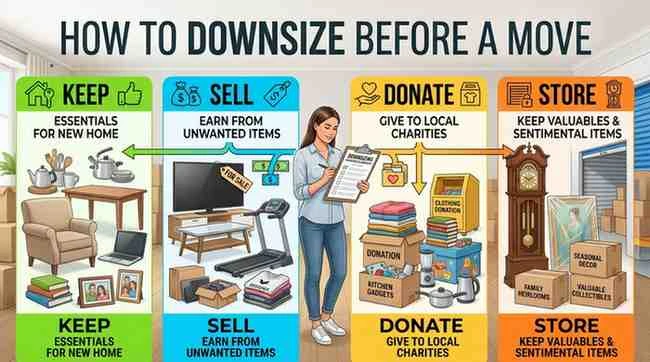
What Is the Keep, Sell, Donate, or Store Method?
The Keep, Sell, Donate, or Store method assigns every item in your home to one of four categories — eliminating the ambiguous “maybe” pile that derails most decluttering attempts.
- Keep: Items going to your new home. Test each one: does it have a specific place and purpose there?
- Sell: Functional items with resale value. Set a realistic price and a firm deadline — if it doesn’t sell in two weeks, donate it.
- Donate: Functional items without strong resale value, or items where the sale effort isn’t worth the return.
- Store: Items that aren’t moving with you yet but aren’t ready to leave your life — sentimental belongings, seasonal items, furniture for a future room.
The power of this framework is that every item gets a decision. Nothing goes in a box labeled “miscellaneous” and moves to the back of a closet in the new home.
What Is the One-Year Rule for Decluttering?
The one-year rule: if you haven’t used an item in the past twelve months and it isn’t seasonal, sentimental, or a genuine safety backup — sell or donate it.
This rule cuts through the “I might need it someday” justification that fills most people’s garages and spare rooms with things they’ll never actually use. It’s not perfect — there are legitimate exceptions — but applied honestly, it’s the single most efficient filter for reducing household volume.

How Do You Set a Downsizing Timeline?
Build your downsizing timeline backward from your move date:
- 8–12 weeks out: Start with low-urgency accumulation spaces — garage, attic, basement, storage rooms
- 6–8 weeks out: Work through main living areas, bedrooms, and home office
- 4–6 weeks out: Begin selling listed items; schedule donation pickups; arrange storage unit if needed
- 2–4 weeks out: Final decisions on remaining items; begin packing keeps
What Should You Keep When Downsizing?
Keep items that are regularly used, have a specific place in your new home, are genuinely irreplaceable, or serve a clear functional purpose in your current stage of life.
The question to ask for every item is not “is this worth keeping?” but “does this earn a place in my next home?” The framing difference matters. The first question invites nostalgia and justification. The second invites clarity.
Keep without question:
- Essential daily-use items across kitchen, bathroom, bedroom, and living areas
- Important documents: tax records, legal documents, property records, medical records, vital documents — these travel with you, not in a moving box
- Furniture that fits your new floor plan and serves your actual lifestyle
- Tools and equipment you use regularly
- Items of genuine irreplaceable value — sentimental or financial
Keep with scrutiny:
- Furniture that “might” work in the new space — if it doesn’t have a clear home there, it probably doesn’t belong
- Collections — a curated collection of what you love versus a complete collection of everything you’ve accumulated
- Clothing — keep what fits, what you wear, and what matches your actual current life
What Should You Sell Before Moving?
Sell items that are functional, in good condition, and have realistic resale value — setting a firm price and a two-week sales window before defaulting to donation.
The goal of selling is recovery of value, not maximization of value. Spending three hours managing a $40 sale is rarely worth it when the same time could be spent on the move itself. Price items to sell, not to hold.
Items with the strongest resale value:
- Furniture in good condition — sofas, dining sets, bedroom furniture, shelving
- Large appliances not moving with you — washers, dryers, refrigerators, chest freezers
- Electronics in good working condition — televisions, audio equipment, gaming systems
- Bicycles, sporting goods, and fitness equipment
- Power tools and equipment
- Collectibles and antiques — these may warrant a specialist rather than a general marketplace
Where to sell:
- Facebook Marketplace for local pickup on furniture and large items — no shipping logistics
- Craigslist for the same category with a slightly different buyer demographic
- eBay for collectibles, electronics, and items with a national buyer pool
- Estate sale companies if you’re clearing an entire home — they handle everything for a percentage
Set a hard deadline. Items that haven’t sold in two weeks go to donation. A donated item is better than an item that moves with you because you ran out of time to sell it.
What Should You Donate Before a Move?
Donate functional items in Idaho that don’t have strong resale value or where the effort of selling outweighs the return — prioritizing donation options that can arrange pickup rather than requiring you to transport items.
Donation works best for: clothing and shoes, kitchen goods and small appliances, books, linens and towels, children’s toys and games, and household décor.
Donation options that reduce your logistics burden:
- Habitat for Humanity ReStores accept furniture and building materials and can arrange pickup for larger items
- Goodwill and Salvation Army have pickup programs for qualifying loads
- Local shelters and transitional housing programs often accept furniture, kitchenware, and household goods directly
- Buy Nothing groups and local Facebook groups can move items quickly and locally without any transport on your part
Schedule donation pickups early — pickup calendars fill up, especially in spring and early fall when moving season peaks. Don’t let donated items sit in your home waiting for a pickup date that’s two weeks away.
What Items Should You Store Instead of Getting Rid Of?
Store items you’re not ready to part with permanently but don’t need immediately in your new home — sentimental belongings, seasonal items, furniture for a future room, and items in a genuine holding pattern.
The store category is the category most people skip — and it’s the one that leads to the most post-move regret. When someone gives away something they later wish they’d kept, it’s almost always because “donate” and “store” weren’t genuinely separated as options. Storage gives you the time to make better decisions.

When Is a Storage Unit a Smart Choice During a Move?
A storage unit is smart during a move when you have items that don’t fit your immediate new home but aren’t ready to leave your life, when your move involves a timing gap, or when you need to stage your current home without permanently parting with anything.
Common scenarios where storage adds genuine value:
- Staging a home for sale: Move excess furniture and personal items into storage so the home shows clean. This is one of the highest-return uses of temporary storage — homes that show well sell faster.
- Timing gaps: Between when you leave one home and when you’re settled in the next. Almost every move involves a gap; a storage unit makes it manageable.
- Furniture for a future room: You’re moving into a two-bedroom but you own a three-bedroom’s worth of furniture. The third bedroom furniture stores until you need it — or until you decide you don’t.
- Sentimental items needing more time: Storage gives you six months to revisit a decision rather than making it in thirty seconds on a moving day deadline.
What Are the Benefits of Self Storage During a Move?
Self storage during a move provides flexibility that the move itself cannot offer. With a month-to-month storage unit requiring no long-term commitment, you pay only for the months you actually need the space. With no deposit required, starting a unit doesn’t add financial pressure to an already expensive transition. And with 24/7 gate access, you can retrieve items whenever your new home is ready for them — not on a facility’s schedule.
For a practical framework on using storage as part of a move, our complete guide on short-term self storage when moving covers the specific logistics of staging belongings in phases and using storage to reduce the pressure of tight moving timelines.
How Can You Downsize Room by Room?
A room-by-room approach — completing one space before starting the next — prevents the whole-house overwhelm that stalls most downsizing efforts. Start with low-emotional-charge spaces and work toward high-charge ones.
Room-by-Room Downsizing Checklist
Garage:
- [ ] Sort all tools — keep what you use, sell quality duplicates, discard broken items
- [ ] Assess all sports and recreational equipment against actual use in the past year
- [ ] Discard or donate seasonal items that are worn out or no longer used
- [ ] Properly dispose of hazardous materials — paint, solvents, pesticides
- [ ] Sell or store large equipment with no immediate home in the new space
Kitchen:
- [ ] Pull everything from every cabinet and drawer before sorting back in
- [ ] Eliminate duplicates — keep one of most tools, two at most for high-use items
- [ ] Donate specialty appliances used fewer than three times per year
- [ ] Discard expired pantry goods; donate unexpired non-perishables
- [ ] Assess serving and entertaining pieces honestly against your actual social life
Bedrooms:
- [ ] Pull all clothing out — sort by what fits, what you’ve worn in twelve months, what represents your actual life now
- [ ] Clear under-bed storage completely and sort everything found there
- [ ] Assess furniture against the floor plan of the new home
- [ ] Sort all dresser and nightstand drawers
Living Room:
- [ ] Apply one-year rule to books, media, and décor
- [ ] Assess all furniture against the new space — measure before deciding
- [ ] Evaluate electronics: what actually gets used versus what gets maintained out of habit
Home Office:
- [ ] Shred or recycle documents beyond their retention period
- [ ] Keep: tax records (seven years), legal documents, property records, medical records
- [ ] Test all electronics before deciding to move them
- [ ] Go through the cable drawer — discard all cables for devices you no longer own
Attic / Basement / Storage Rooms:
- [ ] These spaces most benefit from the one-year rule — items stored out of sight are usually stored out of use
- [ ] Sort seasonal decorations honestly — a curated set of what you love, not everything accumulated
- [ ] Assess any furniture or large items stored here against the new home’s actual floor plan
How Do You Handle Sentimental Items Without Regret?
The key to handling sentimental items during a downsize is separating time pressure from the decision itself — using storage to give yourself weeks or months to decide rather than hours on a moving deadline.
Sentimental items are the category where downsizing most commonly produces regret — not because people should have kept more, but because they made permanent decisions under temporary time pressure. The solution is not to avoid downsizing sentimental items; it’s to give those items the time the decision deserves.
Practical strategies:
Digitize where possible. Photographs, documents, letters, and children’s artwork can be scanned at high resolution and preserved digitally while the physical originals are donated or discarded. This is particularly valuable for paper items that occupy space but whose value is entirely in their content.
Keep the best, not all. If you have a collection of items that represents the same memory — thirty pieces of children’s artwork from kindergarten through fifth grade — keep the ten that genuinely move you and let the others go. The memory doesn’t require the entire archive.
Use storage as a decision buffer. Place items you’re uncertain about in a storage unit with a review date six months out. When you revisit them — without the emotional charge of a move in progress — the decisions often become clearer. Items you can’t remember storing after six months rarely needed keeping.
Involve the people the items are connected to. Children’s toys, family heirlooms, and items with shared meaning sometimes belong with other family members. Passing them forward is often a better outcome than storage and a better outcome than discarding.
What Are the Most Common Downsizing Mistakes to Avoid?
| Mistake | Better Alternative |
|---|---|
| Waiting too long to start | Begin 8–12 weeks before move date, not the week before |
| Keeping too much out of obligation | Apply the one-year rule; keep what you choose, not what you feel guilty releasing |
| Rushing decisions on sentimental items | Use storage as a time buffer — make permanent decisions without artificial deadlines |
| Ignoring the storage option | Storage bridges the gap between “not ready to decide” and “it’s gone forever” |
| Pricing items too high to sell | Price to sell in two weeks; donate anything that doesn’t move |
| Packing first, sorting later | Sort before a single box is packed — packing undecluttered belongings is the core mistake |
| Not measuring furniture against the new floor plan | Measure your new space before deciding what furniture to move |
| Keeping duplicates “just in case” | One of most items is sufficient; the one-year rule handles the rest |
What Is a Complete Downsizing Checklist Before a Move?
8–12 Weeks Before the Move
- Walk every room and storage area with your phone — photograph and inventory what you have
- Confirm your new home’s floor plan and measurements — know what fits before deciding what to keep
- Set up four physical sorting zones: Keep, Sell, Donate, Store
- Start with low-emotional-charge spaces: garage, attic, basement, spare rooms
- Research donation pickup options in your area and schedule early
6–8 Weeks Before 6. List items for sale — set prices, take clear photos, post on relevant platforms 7. Schedule donation pickups for items not going to individual buyers 8. Arrange storage unit for items going into the Store category 9. Work through main living areas, bedrooms, and home office 10. Digitize photographs, documents, and other paper items you’re keeping for content but not physical form
4–6 Weeks Before 11. Follow up on sales; donate any items not sold within two weeks 12. Move Store-category items into storage unit 13. Begin packing Keep items in non-essential rooms first 14. Confirm moving truck or company reservation
2–4 Weeks Before 15. Final pass through all rooms — apply the one-year rule to anything still undecided 16. Pack remaining Keep items; leave only daily-use essentials unpacked 17. Confirm storage unit is organized for easy retrieval after the move
What Does Downsizing Before a Move Look Like in Practice?
Consider a realistic scenario: a couple in their late fifties whose children have moved out are selling a four-bedroom home and moving into a two-bedroom condominium in a nearby city. They’ve lived in the home for twenty-two years.
The challenge: Twenty-two years of accumulated belongings, a furnished guest room that will no longer exist, a garage full of tools and sporting equipment from a family of four, and a basement holding items from three generations of family history.
The approach: They start ten weeks before the move. The basement gets the first two weekends. A combination of family distribution — children taking items that belong to their life stages — and a ruthless one-year rule reduces the basement from packed to manageable. An estate sale company handles the furniture, tools, and household goods in a single weekend.
Storage decisions: A 10×10 unit holds the items that didn’t find homes through the estate sale but that they’re not ready to discard — two pieces of heirloom furniture without a place in the new condo, a collection of art prints that need wall space they won’t have, and three boxes of family photographs requiring proper organization. The plan is to revisit in six months with the decisions removed from the pressure of the move.
Outcome: They arrive at the condo with furniture that fits, boxes they’re genuinely glad to unpack, and a clean start that would have been impossible had they packed first and sorted later. The storage unit gets visited four months later — one heirloom piece goes to a grandchild, one piece finds a corner of the condo they’d underestimated, and the photographs finally get the afternoon of organization they’d needed for years.
Frequently Asked Questions: How to Downsize Before a Move
How do you downsize before a move? Start eight to twelve weeks before your move date. Walk every room, inventory what you have, and sort everything into four categories: Keep, Sell, Donate, or Store. Apply the one-year rule to most items. Move store-category items into a storage unit so they’re out of the way without being permanently gone. Pack only your Keep items.
What is the first step in downsizing a home? The first step is creating a home inventory — walking every room, closet, and storage space with your phone to document what you have. This makes the scale of the task concrete and prevents the avoidance that keeps most people from starting.
What should I keep when downsizing? Keep items you use regularly, items that have a specific place in your new home, genuinely irreplaceable sentimental items, and important documents. Apply the question “does this earn a place in my next home?” rather than “is this worth keeping?”
What should I sell before moving? Furniture in good condition, large appliances not moving with you, electronics, sporting equipment, tools, and collectibles. Use Facebook Marketplace and Craigslist for local pickup items. Set a two-week sell window — items that haven’t sold get donated.
Should I rent a storage unit when downsizing? Yes, in most cases. A storage unit separates the “not ready to decide” category from permanent decisions, bridges the timing gap in almost every move, and allows you to stage your current home without giving things away permanently. Month-to-month storage with no deposit is built exactly for this.
How do I declutter before moving without regret? Use storage as a buffer for items you’re uncertain about — give yourself six months to revisit the decision rather than making it on a moving day deadline. Digitize what can be digitized. Involve family in decisions about shared items. Keep the best of each category, not all of it.
How far in advance should I start downsizing? Eight to twelve weeks before your move date is the practical minimum. Starting earlier is almost always better — rushed downsizing produces the most regret and the most wasted money on moving things you didn’t actually want.
What is the one-year rule for decluttering? If you haven’t used an item in the past twelve months and it isn’t seasonal, sentimental, or a genuine safety backup — sell or donate it. Applied honestly, this single rule eliminates most of the accumulation in any household.
How can downsizing reduce moving costs? Every item not moved is an item not packed, loaded, transported, and unloaded. Professional movers price by weight and volume — a meaningfully lighter, smaller load costs measurably less. Even for self-managed moves, fewer items means fewer trips and a smaller truck.
What should I do with sentimental items when downsizing? Give them time rather than pressure. Use a storage unit as a decision buffer — items you’re uncertain about go into storage with a review date, allowing you to make the decision without the emotional charge of a move in progress. Digitize where the value is in content rather than the physical object. Keep the best examples, not the complete collection.
Final Thoughts on How to Downsize Before a Move
The fundamental insight behind knowing how to downsize before a move is this: the decisions you make about your belongings before packing begins determine nearly everything about how the move feels and how well your new home functions.
Every item that doesn’t make the journey is one you don’t pack, move, unload, or find a place for. Every item that arrives in your new home should be there because you chose it — not because you ran out of time to decide otherwise. That distinction is the difference between a fresh start and a relocated version of the same accumulated weight.
The process works when you start early, apply a consistent sorting framework, use storage as a legitimate option rather than a form of avoidance, and give sentimental items the time they deserve rather than the thirty seconds they get on a moving day deadline.
If you’re in the middle of a downsize or preparing for one, our room-by-room decluttering checklist gives you a parallel framework for the room-by-room approach, and the moving to Idaho guide covers the relocation planning side for anyone making the move to the Clearwater Valley.
Share this guide with anyone navigating a downsize — and explore storage options in Kamiah and Kooskia if you need a secure, flexible holding space during your transition.
📞 Elk Country Storage Co.: (208) 630-3753 🌐 Reserve a unit: elkcountrystorageco.com/reserve
Related Resources from Elk Country Storage Co.:
- Short-Term Self Storage When Moving — Using storage to bridge your move
- Month-to-Month Storage — Flexible terms for the store category during a downsize
- No-Deposit Storage — Start your downsizing storage unit without upfront cost
- Decluttering Before a Move: Room-by-Room Checklist — A parallel systematic framework for every room
- Moving to Idaho: What to Know Before You Move — Relocation planning for Clearwater Valley newcomers