
Introduction
The last campfire of the season has gone cold. The tent is down, the sleeping bags are rolled, and the gear is piled somewhere in your truck bed or back corner of the garage. Sound familiar?
For campers across the Clearwater Valley — from Kamiah to Kooskia, Orofino to Grangeville — the end of camping season comes fast, and the temptation to just deal with it later is real. But how you store camping gear in winter makes a direct difference in whether that gear is ready to go when spring arrives or whether you’re replacing moldy sleeping bags and a cracked tent pole before your first trip of the year.
This guide covers exactly what you need to know: how to clean and prepare each category of camping gear, what storage options work best, why some materials need more care than others, and how a secure storage unit in Kamiah or Kooskia can be a genuinely practical solution for protecting your outdoor investment. By the end, you’ll have a clear plan — and a ready checklist — for winter storage that actually works.
Why Proper Winter Camping Gear Storage Matters
Before we get into the how, it’s worth understanding the why. Camping gear is not cheap. A quality four-season tent, a good down sleeping bag, a reliable camp stove, and a full set of cookware add up to hundreds — sometimes thousands — of dollars of equipment. Improper storage puts all of that at risk.
Here’s what happens to camping gear that isn’t stored correctly over winter:
- Mold and mildew grow on tents, sleeping bags, and packs that were packed away even slightly damp
- Moisture and humidity cause rust on cookware and tools, corrosion on battery terminals, and delamination on sleeping pads
- Compressed storage destroys the loft of down and synthetic sleeping bags, reducing their warmth permanently
- UV exposure and temperature swings in uninsulated garages cause rubber seals and plastic components to crack
- Rodents nest inside stored equipment, chewing through gear bags, sleeping bag baffles, and tent fabric
- Flat-spotting and cracking affect foam sleeping pads and cooler seals when left in sub-freezing temperatures
Getting the storage right is, simply put, how you protect your investment and enjoy it for years longer.
Step 1: Clean Everything Before It Goes Into Storage
This is the step most people skip — and the step that causes the most damage. Never store camping gear dirty. Residual food smells attract pests. Moisture and debris left on gear becomes the foundation for mold growth over winter.
Tents
Shake out all debris, dirt, and insects. Set the tent up — either outside or in your garage — and wipe down the interior and exterior with a damp cloth. Pay particular attention to the tent floor and any areas that were in contact with wet ground. Let it air dry completely before packing. Even a few hours of moisture sealed inside a storage bag is enough to start mold growth over a long winter.
Clean the zipper teeth with a soft brush and apply a zipper lubricant if available. Check and repair any small tears now — small damage becomes big damage in storage.
Sleeping Bags
Sleeping bags should be washed according to their care label before storage. Most synthetic bags can go in a large front-load washing machine on a gentle cycle with mild detergent. Down bags require either a specialized down cleaner or a professional laundry. After washing, dry thoroughly — and then dry again. Down especially retains moisture deep in the baffles and must be completely dry before long-term storage.
Critical: Never store a sleeping bag compressed in its stuff sack over winter. Compression permanently damages the insulation’s loft over time, reducing warmth. Store sleeping bags loosely in a large mesh or breathable cotton bag, or hang them if space allows.
Cookware and Camp Kitchen Gear
Wash all cookware, utensils, and food containers thoroughly to remove grease, food residue, and odors. Dry everything completely before packing. Cast iron should be cleaned, dried, and lightly oiled to prevent rust. Separate gas canisters from stoves — check local disposal guidelines for partially used fuel canisters.
Remove food from all coolers and wipe the interior with a mild bleach solution to prevent mold and odors. Store coolers with the lid slightly open or propped to allow airflow.
Hydration Gear and Water Filters
Backpacking water filters are particularly susceptible to winter damage. Any water left in the filter membrane can freeze, expand, and crack the filtration media — permanently ruining a $70–$150 filter. Backflush and dry your water filter thoroughly, or store it according to the manufacturer’s winter storage guidance. Some filters can be stored in a zip-lock bag with a small amount of water in a non-freezing location.
Hydration bladders should be cleaned, dried, and stored with the bladder slightly open to prevent mold.
Clothing and Footwear
Wash all camp clothing, base layers, and rain gear before storage. Dirty clothing attracts insects and can develop odors and staining that are difficult to remove after sitting all winter. Waterproof and breathable outerwear should be washed with a technical detergent and re-treated with DWR (durable water repellent) spray if the water-beading performance has declined.
Clean and dry hiking boots and camp shoes. Stuff boots with newspaper to maintain their shape, apply a leather or synthetic conditioner, and store in a cool, dry location away from UV exposure.
Camping Electronics
Camping electronics — headlamps, GPS devices, portable radios, and battery-powered lanterns — need specific attention before storage. Always remove batteries before winter storage. Batteries left inside electronics can leak corrosive material, ruining the device completely. Store batteries separately in a cool, dry location, not in a hot garage or freezing shed.
Wipe contacts clean and store electronics in a dry, padded bag or case. Avoid leaving electronics in vehicles or unheated spaces where extreme temperature swings can damage screens and circuit components.
Sleeping Pads
Foam sleeping pads can be stored rolled or flat in a cool, dry location. Inflatable sleeping pads should be cleaned, dried, and stored slightly inflated — not fully pressurized, but with just enough air to keep the interior from sticking together. Avoid storage in areas with sharp temperature swings, which can stress the valve and seam materials.
Step 2: Sort and Organize Before You Store
Winter storage is the perfect time to take inventory of your gear and organize systematically. It saves enormous time in spring when you’re trying to get out the door for your first trip and can’t find the camp stove igniter.
Organize by Category
Group your camping gear into logical categories:
- Shelter: Tent, footprint, stakes, guylines, poles
- Sleep system: Sleeping bag, sleeping pad, pillow
- Camp kitchen: Stove, fuel, cookware, utensils, cutting board, food storage
- Clothing and layers: Base layers, mid-layers, rain gear, camp shoes
- Lighting: Headlamps, lanterns, spare batteries
- Navigation and electronics: GPS, maps, radio, phone mounts
- First aid and safety: First aid kit, emergency blanket, fire starters
- Packs and bags: Backpacks, dry bags, stuff sacks
- Hygiene and camp comfort: Trowel, biodegradable soap, comfort items
Label Everything Clearly
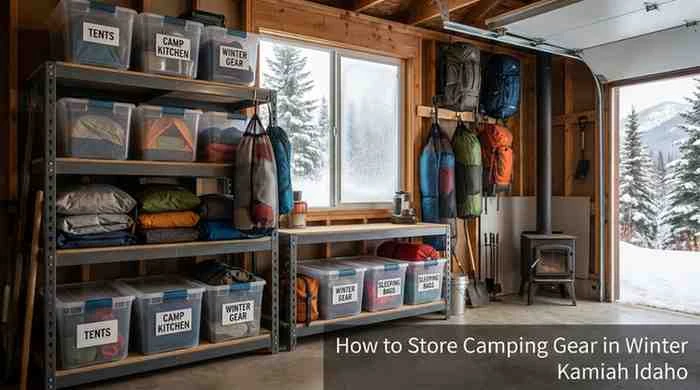
Label your storage bins on the front, side, and top. In a storage unit or a packed garage, the bin you need is almost always the one at the back or the bottom. Clear labeling means you can identify contents without unstacking everything. Use waterproof labels or a permanent marker on tape — standard paper labels peel off in humidity.
Create a Camping Gear Inventory
A simple list — even a note on your phone — of what you stored, where it’s located, and what condition it was in when stored makes spring prep dramatically faster. It also helps you identify items that need replacing before the season starts, rather than discovering the problem at the trailhead.
Step 3: Choose the Right Storage Containers
What you store your gear in is nearly as important as how you prepare it.
Use Stackable Plastic Bins with Lids
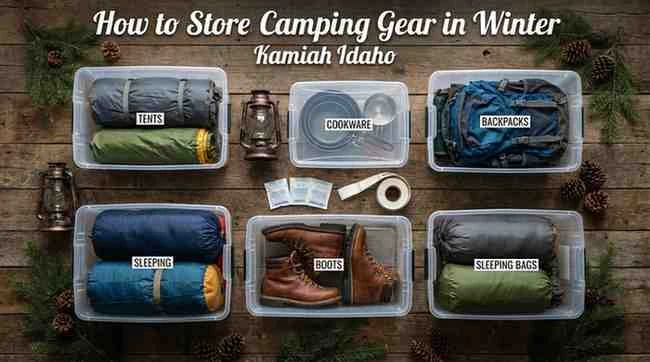
Sturdy, stackable plastic bins with secure lids are the gold standard for camping gear storage. They protect against moisture, dust, insects, and rodents. Choose bins that are uniform in size so they stack cleanly on shelves or in a storage unit. Avoid cardboard boxes for long-term or winter storage — cardboard absorbs moisture, attracts pests, and collapses under weight.
Add Silica Gel Packets for Moisture Control
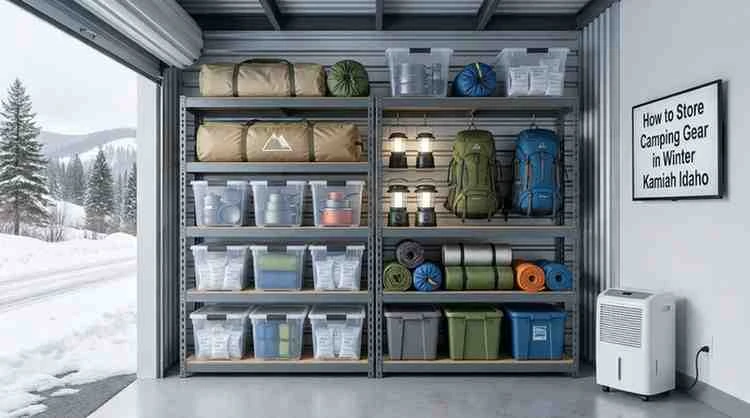
Toss a few silica gel desiccant packets into bins containing electronics, sleeping bags, tents, and clothing. These absorb ambient humidity and help prevent mold and corrosion inside sealed containers. They’re inexpensive, effective, and reusable — just “recharge” them by spreading them on a baking sheet in a low oven.
Use Breathable Bags for Sleeping Bags and Down Items
As mentioned above, sleeping bags and down insulation need to breathe. Store these items in large, breathable mesh or cotton bags — never airtight plastic — to allow moisture vapor to escape while protecting from dust and light.
Hang Packs When Possible
Backpacks and hiking packs store best when hung rather than compressed. If you have hooks or a shelving system, hang packs by their top loops to maintain their structure and allow airflow.
Step 4: Choose the Right Storage Location
Where you store your camping gear matters as much as how you prepare it. Let’s look at the main options for Clearwater Valley campers.
Garage Storage
Pros:
- Convenient and immediately accessible
- No monthly rental cost
- Easy to access during the off-season for gear checks
Cons:
- Unheated garages in Kamiah and Kooskia experience significant temperature swings between winter and summer
- Humidity and condensation can damage sensitive gear
- Limited space for large families or avid campers with substantial gear collections
- Rodent access in rural Idaho is a real risk
Garage storage works reasonably well for durable, non-sensitive items: bins of cookware, camp chairs, lanterns, and tools. For sleeping bags, tents, electronics, and anything sensitive to moisture or temperature, a climate-controlled environment is a safer long-term choice.
Home Interior Storage
Storing gear in a basement, spare bedroom, or closet offers better temperature stability than a garage. The limitations are primarily space and convenience — not everyone has a spare room dedicated to camping gear, and hauling large bins through the house isn’t always practical.
Self Storage Unit
A self-storage unit at a facility like Elk Country Storage Co. in Kamiah or Kooskia offers several real advantages for serious campers:
- Dedicated space that doesn’t eat into your living area or garage
- 24/7 gate access so you can retrieve gear whenever you need it — even during an unseasonably warm January day
- Climate-controlled unit options to protect sleeping bags, electronics, tents, and other sensitive gear from Idaho’s temperature extremes and humidity
- Flexible month-to-month rental — store your gear from October through April and stop renting when camping season returns
- No deposit required to get started
For families with substantial camping gear collections, hunters with seasonal equipment, or anyone whose garage has run out of room, a self-storage unit is a genuinely practical solution — not just a last resort.
Garage vs. Home vs. Self Storage: Side-by-Side Comparison
| Factor | Garage | Home Interior | Self Storage Unit |
|---|---|---|---|
| Temperature stability | Low (cold winters) | Medium-High | High (climate-controlled) |
| Humidity control | Low | Medium | High (with climate control) |
| Rodent risk | High (rural Idaho) | Low | Low |
| Convenience | High | Medium | Medium |
| Space flexibility | Limited | Limited | Expandable by unit size |
| Cost | Free | Free | Monthly rental |
| 24/7 access | Yes | Yes | Yes (Elk Country Storage Co.) |
| Best for | Durable gear | Small collections | Large or sensitive gear |
Real-Life Scenarios: How Clearwater Valley Campers Store for Winter
Scenario 1: The Weekend Camping Family
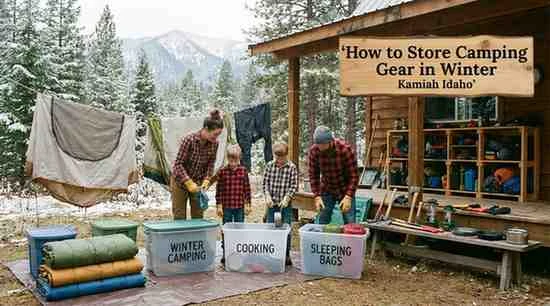
The Reinhardt family in Kooskia camps most weekends from May through September. They have a six-person tent, four sleeping bags, two sleeping pads, a full camp kitchen setup, and a collection of packs and clothing. Their garage is already full of their vehicle and yard equipment.
Rather than cramming gear into the corners, they rent a 5×10 storage unit at Elk Country Storage Co. in Kooskia. They clean and prep everything in October, pack it into labeled stackable bins and breathable bags, and store it until May. The 24/7 gate access means they can grab specific items during winter for day trips or hunting season. When spring arrives, everything is organized, protected, and ready.
Scenario 2: The Solo Backpacker with Sensitive Gear
Jake in Kamiah is a serious backpacker with high-quality, lightweight gear — a $300 down sleeping bag, an ultralight tent, a GPS device, and a hydration filtration system. He can’t afford to replace any of it due to poor storage. He rents a small climate-controlled unit to protect his down bag and electronics from Idaho’s freeze-thaw cycles, using a 5×5 unit that more than covers his needs for a modest monthly cost. In spring, everything is exactly as he left it.
Frequently Asked Questions
How do you store camping equipment properly for winter? Clean everything thoroughly, dry it completely, sort by category, pack in labeled stackable plastic bins, add silica gel packets for moisture control, store sleeping bags in breathable bags (never compressed), remove batteries from electronics, and choose a dry, temperature-stable storage location.
Should camping gear be stored in plastic bins? Yes. Sturdy plastic bins with secure lids are the best option for most camping equipment. They protect against moisture, dust, insects, and rodents. Use breathable bags instead of plastic for sleeping bags and down items.
Can tents be stored in garages over winter? It depends on the garage. If the tent is completely clean and dry, and the garage stays reasonably dry and doesn’t get extreme cold, a garage can work. However, for long-term storage in rural Idaho where garages get cold and humid, a climate-controlled storage unit is better protection.
Do sleeping bags need breathable storage? Yes. Sleeping bags — especially down bags — should always be stored in a large, loose, breathable bag, not compressed in a stuff sack. Compression over months permanently damages insulation loft and warmth.
Should I remove batteries from camping electronics before winter storage? Always. Batteries left inside devices during long-term storage can leak and corrode the device beyond repair. Remove batteries and store them separately in a cool, dry location.
How do you prevent mold on camping gear? The single most important step is ensuring everything is completely dry before storage. Add silica gel desiccant packets to storage bins. Store in a climate-controlled or dry indoor environment. Avoid airtight sealing of items that may have residual moisture.
What size storage unit do I need for camping gear? For most families, a 5×10 unit comfortably holds a full camping kit. Larger collections or if you’re also storing hunting gear, fishing equipment, or RV accessories may warrant a 10×10 or larger. Call Elk Country Storage Co. at (208) 630-3753 to talk through the right size for your situation.
How long can camping gear stay in storage? Properly prepared and stored camping gear can remain in storage indefinitely without degradation. Annual checks are a good habit — inspect for moisture, pest activity, and condition before the season starts.
Where should camping equipment be stored in winter? Indoors in a climate-stable environment is ideal. Options include a climate-controlled storage unit, a temperature-stable basement or interior room, or a well-insulated garage. Avoid unheated sheds, outdoor storage, or locations with high humidity.
Conclusion
Knowing how to store camping gear in winter is the difference between a smooth season opener and a frustrating, expensive gear-replacement situation before your first trip. The steps aren’t complicated, but they matter: clean everything thoroughly, dry it completely, organize by category, label your bins, choose the right containers, and store in a protected, temperature-stable environment.
For campers across the Clearwater Valley — from Kamiah to Kooskia, Orofino to Grangeville — Elk Country Storage Co. offers a practical, local solution. Whether you need a small 5×5 unit for a backpacking kit or a larger space for a full family camping setup, the combination of climate-controlled options, 24/7 gate access, no deposit required, and flexible month-to-month rentals makes it easy to protect your gear through Idaho’s harshest months and be ready the moment camping season returns.
Ready to Protect Your Camping Gear This Winter?
Don’t leave your investment exposed to mold, moisture, rodents, and Idaho’s temperature swings. Store smart with a secure, flexible unit at Elk Country Storage Co.
📦 Reserve a Unit Online → elkcountrystorageco.com/reserve 📞 Call: (208) 630-3753 📧 Email: elkcountrystorageco@gmail.com
Kamiah: 303 Locust Rd, Kamiah, ID 83536 | Kooskia: 4689 Hwy 13 South, Kooskia, ID 83539
Month-to-month rentals. No deposit required. 24/7 gate access. Climate-controlled options available.
Elk Country Storage Co. serves Kamiah, Kooskia, Orofino, Grangeville, Stites, Harpster, Lewiston, and the greater Clearwater Valley, Idaho.