

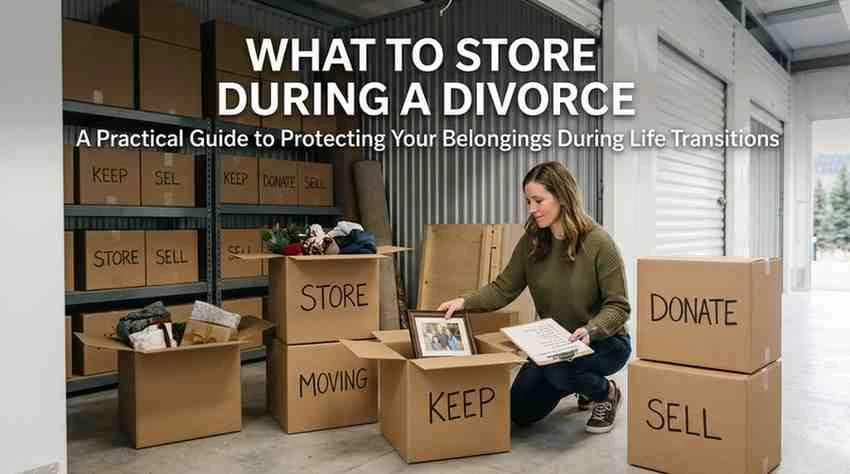
Divorce is one of the most disorienting life transitions a person can go through. Beyond the emotional weight, there are hundreds of practical decisions that demand your attention at exactly the moment when decision-making feels hardest. What happens to the furniture? Where do the shared household items go? What do you do with belongings that belong to both of you — and neither of you is ready to let go?
Knowing what to store during a divorce can remove a significant amount of that pressure. A self storage unit gives you a neutral, secure place to put belongings while you and your former spouse work through the details of property division. It creates breathing room. It prevents hasty decisions you might regret. And it keeps your personal and shared belongings safe while your living situation stabilizes.
This guide walks you through every aspect of using self storage during divorce — from which items belong in a unit, to how to organize your space, to the mistakes most people make when they’re too overwhelmed to think clearly.
What Should You Store During a Divorce?
The most straightforward answer: store anything that doesn’t need to be where you’re currently living, but isn’t ready to be permanently given away, sold, or assigned to one person.
Divorce proceedings take time. Property division negotiations take time. Selling a marital home takes time. During that window — which can span weeks or months — a storage unit serves as a holding space for your life in transition.
Using self storage during divorce helps in three specific ways. First, it reduces physical clutter in the home you’re still occupying, which reduces daily stress. Second, it protects items that could become disputed assets from being damaged, lost, or discarded in the chaos. Third, it gives you time. Time to think, time to grieve, time to decide carefully rather than reactively.
Temporary storage during divorce is not a permanent solution — it’s a strategic pause. That distinction matters.
Which Household Items Are Best Kept in Storage During a Divorce?
Most shared household items are good candidates for temporary storage during separation, particularly anything that isn’t being used in the home you’re currently occupying.
Furniture is the most common category. Extra sofas, dining tables, bedroom sets, bookshelves, and office furniture can be stored safely while you determine which pieces each party will keep. There’s no point in both people fighting over a dining set when neither of them currently needs it in their temporary residence.
Appliances — particularly spare refrigerators, washing machines, or appliances from a second kitchen or garage — are also excellent storage candidates. They’re large, valuable, and often contentious. Getting them out of the shared space removes a daily source of conflict.
Seasonal items such as holiday decorations, outdoor furniture, gardening equipment, and sports gear can go into storage immediately. These items rarely generate emotional disputes and free up significant space in a home that may be going on the market.
Décor, artwork, and collectibles are worth storing early in the process. These items are easy to damage during a tense period of shared occupancy, and their sentimental or monetary value makes them worth protecting. If you’re uncertain whether an item will be contested, putting it in storage protects it from both damage and accusations.
Excess kitchen items — extra sets of dishes, small appliances, duplicate cookware — can be boxed and stored with minimal disruption to daily life.

Should Sentimental Items Be Placed in Storage?
Yes — and often, the sooner the better.
How Can Storage Protect Family Keepsakes?
Family keepsakes are among the most emotionally charged items in any divorce. Heirlooms, gifts, inherited furniture, handmade items, and children’s memorabilia can disappear, be damaged, or become bargaining chips in a contentious split. Placing them in a secure storage unit protects them from all of those outcomes.
If an item carries significant personal or financial value and might be disputed during proceedings, removing it to a secure, documented storage space — with an inventory list — can also protect you legally. Note: consult your divorce attorney in kamiah id before removing contested assets from the marital home. This is general organizational guidance, not legal advice.
For delicate or high-value keepsakes, it’s worth considering a climate-controlled storage unit, which protects against temperature and humidity damage that can ruin antiques, wood furniture, photographs, and fabric items over time.
What Should You Do With Photo Albums and Personal Memories?
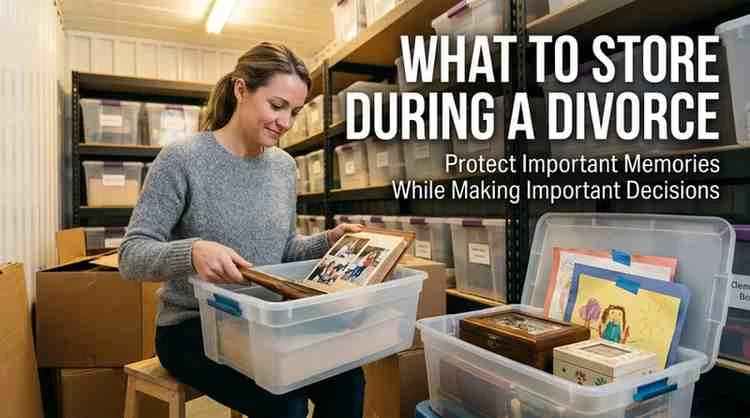
Photo albums and personal memory items present a specific challenge during divorce: both parties may feel entitled to them, and they can’t always be duplicated. The practical solution is to place physical albums and irreplaceable memory items in storage until a calm, agreed-upon process for dividing or digitizing them can be arranged.
If you have the capacity, digitize photographs before the divorce proceedings become more adversarial. Scanned copies of important photos can be shared with both parties, removing the friction entirely. The originals can then be stored safely until a final decision is made.
Why Is Storage Better Than Making Emotional Decisions Too Quickly?
Under emotional stress, people make decisions they later deeply regret — giving away items they loved, throwing things out in anger, or agreeing to terms that disadvantage them simply to end a conflict faster. Storage removes that urgency.
When an item is in a storage unit, it’s not gone. You haven’t committed to anything. You’ve simply created space and time, which are two of the most valuable resources available to anyone going through a separation.
Can a Storage Unit Help When Selling a Marital Home?
Selling a marital home is one of the most stressful elements of divorce, and self storage is one of the most effective tools for making it go smoothly.
Buyers purchase the idea of a life they could have in your space. That means your home needs to feel open, neutral, and uncluttered — exactly the opposite of what a home looks like when two people are sorting through decades of shared possessions. A storage unit lets you remove the surplus so your home shows at its best.
Staging a home for sale typically involves removing at least 30–50% of the furniture currently in it. Extra chairs, second sofas, personal collections, family photos, children’s artwork, and oversized furniture pieces all go into storage so buyers can see the bones of the house rather than your life inside it.
This is directly related to decluttering before a move — a process worth starting early. Our room-by-room decluttering guide at Decluttering Before a Move: A Room-by-Room Checklist walks through exactly how to approach this category by category, which is especially useful when you’re trying to divide and sort belongings at the same time as preparing for a sale.
Beyond staging, storage also provides a neutral drop-point for items whose ownership is still being negotiated. Rather than leaving them in the home (where they can be damaged during showings or cause conflict) or taking them to one party’s temporary residence (which can complicate ownership claims), a shared or individual storage unit keeps things secure until the sale closes.
What Should Not Be Stored During a Divorce?
Some items should stay with you at all times — not because they’re not storable, but because you’ll need them, or because losing access to them could cause serious problems.
| Store These Items | Keep With You |
|---|---|
| Extra furniture and duplicate appliances | Legal documents (divorce papers, deeds, wills) |
| Seasonal décor and outdoor gear | Financial records (tax returns, bank statements, investments) |
| Artwork, collectibles, and heirlooms | Identification (passport, Social Security card, birth certificate) |
| Excess kitchen items and linens | Daily-use medications and medical records |
| Children’s outgrown items and memorabilia | Insurance documents |
| Second sets of tools or hobby equipment | Irreplaceable originals (one-of-a-kind photos, handwritten letters) |
| Furniture from rooms no longer in use | Valuables requiring immediate access (jewelry, electronics) |
| Books, décor, and non-essential items | Children’s current school records and essential daily items |
The principle is straightforward: if you would need it in an emergency, or if losing access to it could affect your legal or financial position, keep it with you. Everything else is a candidate for the storage unit.
How Can Self Storage Help When Downsizing After Divorce?
After a divorce, most people move into a smaller home than the one they shared. An apartment, a rental property, a smaller house — the square footage drops, and suddenly the furniture and possessions that filled a four-bedroom home don’t fit anywhere.
Self storage during this transition prevents two of the most common post-divorce mistakes: getting rid of things too quickly, and filling a new small space with items that don’t belong there.
When you’re downsizing after divorce, storage lets you move into your new home with only the essentials, then gradually sort through what remains in storage as your life stabilizes. You make decisions about what to keep, sell, donate, or give away on your own timeline — not under the pressure of a moving truck and an empty apartment.
For a detailed walkthrough of managing a major life transition involving a smaller home, our guide to downsizing before a move covers the specific decisions most people face when their space shrinks significantly.
If your transition involves short-term housing before you settle into a permanent place — staying with family, renting month-to-month, or using temporary accommodation — short-term self storage is specifically designed for this kind of flexible, transitional period. You’re not committing to long-term storage fees for items you’ll need again in six months.
How Do You Organize a Storage Unit During a Divorce?
Good organization during an already chaotic time pays dividends every single time you need to access the unit. A disorganized storage unit becomes another source of stress — and during a divorce, you have enough of those.
Follow this step-by-step process:
Step 1 — Create a written inventory before anything goes in. List every item, take photographs, and note its condition. This protects you legally if items become disputed and helps you remember what you have.
Step 2 — Label every box on the top and at least one side. Label with the room of origin and a brief content summary. “Kitchen — pots and pans” is more useful than “Box 7.”
Step 3 — Store items you’re likely to need toward the front. If you’ll need your winter clothing in three months, don’t put it behind the sectional sofa.
Step 4 — Use consistent box sizes where possible. Uniformly sized boxes stack safely and maximize vertical space.
Step 5 — Keep a master inventory list somewhere outside the unit. A digital copy on your phone or in cloud storage means you can check what’s in the unit without driving there.
Step 6 — Leave a center aisle. Walking paths through the unit make retrieval possible without unloading everything.
Step 7 — Use the vertical space. Shelving units inside a storage space dramatically increase how much you can store without stacking boxes unsafely.
Not sure what size unit you’ll need? The Elk Country Storage Unit Size Guide helps you estimate based on the volume and type of items you’re storing.
What Are the Biggest Mistakes People Make When Using Storage During Divorce?
| Mistake | Why It Happens | Better Solution |
|---|---|---|
| Waiting too long to get a unit | Hoping the situation resolves quickly | Secure a unit early — you can always use it less than expected |
| Storing everything without sorting | Overwhelm and indecision under stress | Do a basic sort before moving items in: keep, store, donate, discard |
| No inventory of what went in | Moving fast, assuming you’ll remember | Photograph and list every item before it enters the unit |
| Poor labeling | Boxes packed in a hurry | Label top and side of every box — content and room |
| Choosing the wrong unit size | Underestimating volume, or not checking a guide | Use a size guide before reserving |
| Mixing both parties’ belongings without documentation | Trying to solve everything at once | Keep each party’s items clearly separated and documented |
| Forgetting about ongoing costs | Focus on the immediate move | Factor monthly storage costs into divorce budgeting from the start |
| Not using climate control for sensitive items | Assuming all items are durable | Wood furniture, photographs, and fabrics need temperature-stable storage |
What Does a Real-Life Divorce Storage Scenario Look Like?
Consider a couple in a four-bedroom home in a rural Idaho community who decide to separate after 14 years of marriage. They have a teenager still at home, shared furniture accumulated over the marriage, and a house they’ve agreed to sell.
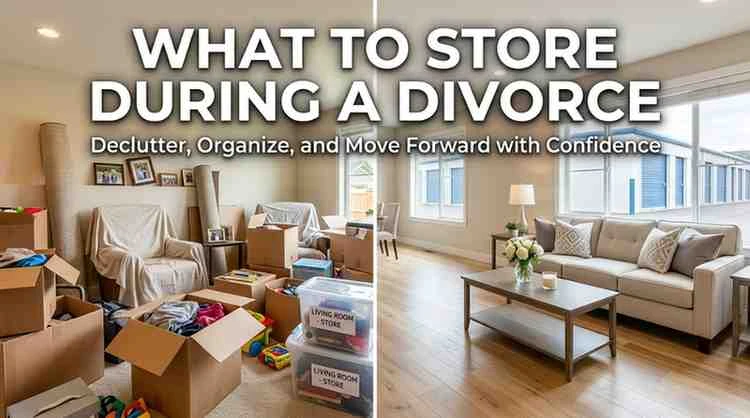
Month 1: One partner moves into a rental apartment. Rather than moving all their share of the furniture — which far exceeds what the apartment can hold — they take only what they immediately need: a bed, a dresser, a kitchen table, and basic appliances. Everything else goes into a 10×20 storage unit. They document everything with photos and a spreadsheet before it leaves the house.
Month 2–3: The marital home is listed for sale. The remaining partner removes half the furniture to the same storage facility (a separate unit), leaving the house staged and spacious for showings. The home sells within six weeks of listing.
Month 4: With proceeds from the home sale in hand and the divorce finalized, both parties visit their respective units. They’ve had three months of emotional distance from the objects inside. Decisions that would have been fights in Month 1 are now calm, practical choices. Some furniture is divided. Some is sold. Some is donated.
The storage unit didn’t resolve the divorce. But it gave both people the time and space to get through it without making permanent decisions during their worst moments.
Frequently Asked Questions
What should I store during a divorce? Store items you don’t immediately need but aren’t ready to permanently assign or discard — extra furniture, appliances, seasonal items, collectibles, artwork, and shared household goods. Keep legal documents, financial records, identification, and daily-use essentials with you at all times.
Is self storage useful during separation? Yes. Self storage during separation creates a neutral space for belongings, reduces conflict by removing items from shared living spaces, and gives both parties time to make considered decisions about property division.
Can a storage unit help reduce conflict during divorce? It often does. When disputed or shared items are in a neutral storage space rather than in one party’s home, they’re less likely to be a daily source of tension. Documented storage also reduces accusations of items being damaged or removed.
Should I store sentimental items? Yes, particularly if they’re at risk of damage, loss, or becoming contested. For fragile or valuable keepsakes, use a climate-controlled unit to protect against temperature and humidity.
What furniture should go into storage? Any furniture not currently being used in your occupied residence — duplicate bedroom sets, extra seating, dining furniture, desks, and storage pieces. If you’re selling the marital home, staging typically requires removing 30–50% of existing furniture.
How long should I keep items in storage after divorce? As long as you need to. Most people keep items in storage for three to twelve months following a divorce — long enough to let their living situation stabilize and allow for clear-headed decisions about what to keep.
Can storage help when selling a home during divorce? Significantly. Decluttering and staging a home for sale is much easier when surplus furniture and personal items are in storage rather than competing for space with potential buyers’ imaginations.
What items should stay with me instead of going into storage? Legal documents, financial records, identification documents, daily medications, insurance paperwork, and any items of irreplaceable personal significance that cannot be duplicated or replaced.
Is storage helpful when downsizing after divorce? Essential, in most cases. Moving from a shared family home into a smaller solo residence almost always means you have more belongings than space. Storage bridges that gap while you make long-term decisions about what belongs in your new life.
How can I organize belongings during a separation? Create a written and photographic inventory, label every box clearly, separate each party’s belongings, use a consistent labeling system, and maintain a digital copy of your inventory outside the unit.
Final Thoughts on What to Store During a Divorce
Divorce is hard enough without turning every object in your home into a decision you have to make right now. Knowing what to store during a divorce — and acting on that knowledge early — is one of the most practical, stress-reducing choices you can make during an already difficult transition.
The goal of self storage during this period isn’t to delay the inevitable. It’s to create the conditions where good decisions can actually happen: space, time, and the absence of daily pressure from objects that carry complicated histories.
Store what you’re not ready to decide about. Keep what you genuinely need access to. Protect what’s irreplaceable. And give yourself permission to sort through the rest when you’re ready — not when the chaos of the initial separation demands it.
If you’re navigating a life transition and need flexible, month-to-month storage in Central Idaho, Elk Country Storage Co. has units available in Kamiah and Kooskia. You can reserve online or reach us directly at (208) 630-3753.
Have a question about storage during divorce or separation? Leave a comment below, share this guide with someone who might need it, or explore our other moving and downsizing resources to help you through this transition.