
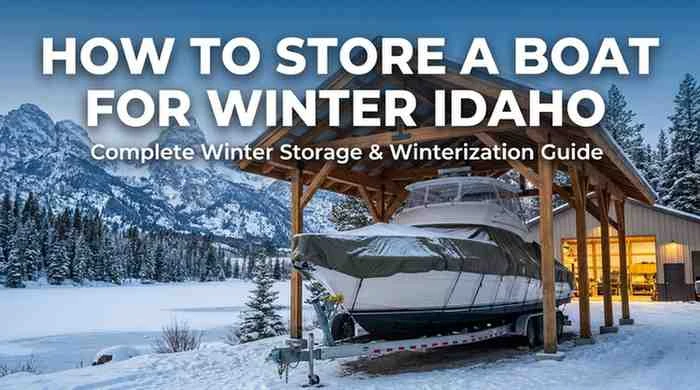
Idaho’s winters are not forgiving to improperly stored boats. From the Clearwater River corridor to the Snake River reservoirs, boat owners across the state face the same seasonal reality every fall: freezing temperatures, snow accumulation, moisture intrusion, and months of exposure that can turn a well-maintained watercraft into an expensive repair bill if the off-season preparation isn’t done right.
How to store a boat for winter in Idaho involves more than finding a place to park it. It means systematically protecting the engine, fuel system, freshwater plumbing, electrical components, hull, and interior from the specific damage that Idaho winters cause — and doing it in the right sequence before the first hard freeze arrives.
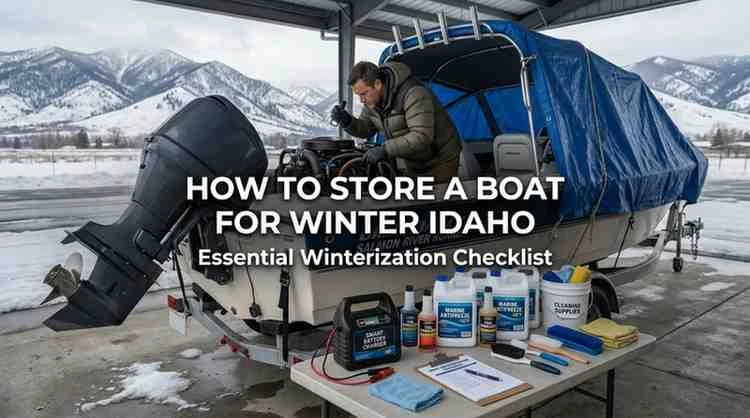
This guide covers every step: cleaning and inspection, engine winterization for both outboard and inboard motors, fuel stabilization, battery care, cover selection, storage type comparison, and a complete checklist you can follow before your boat goes away for the season. Whether you’re a first-time boat owner or a veteran seasonal boater, the steps below will protect your investment and have you ready to launch the moment the water opens in spring.
How to Store a Boat for Winter in Idaho: The Complete Overview
Storing a boat for winter in Idaho requires completing winterization before temperatures drop below freezing — typically by mid-to-late October in most of the state.
The core process has five phases:
- Clean the boat — interior and exterior — to prevent mold, odor, and corrosion during storage
- Stabilize the fuel system and drain or treat freshwater systems to prevent freeze damage
- Winterize the engine — outboard or inboard — using fogging oil, gear lube changes, and marine antifreeze where applicable
- Prepare and store the battery to prevent freeze damage and capacity loss
- Select the right storage — indoor, covered, or outdoor — and protect with an appropriate boat cover or shrink wrap
Skip any of these steps and you’re gambling against Idaho’s weather. Skip the engine winterization and risk cracked blocks, corroded cylinders, and seized components. Skip the fuel stabilization and face gummed injectors and carburetor damage in the spring. Skip the freshwater system draining and get cracked hoses, fittings, and pump housings when the temperature drops below 32°F.
Common mistakes to avoid:
- Waiting until after the first freeze to start winterization
- Leaving standing water anywhere in the plumbing system
- Using a tarp instead of a purpose-built boat cover
- Storing a boat with a partially charged battery
- Neglecting the bilge, livewell, and baitwell draining
Why Is Winter Boat Storage Important in Idaho?
Idaho winters create specific conditions that cause measurable, expensive damage to boats that aren’t properly prepared and stored.
Freezing Temperatures
In most of Idaho — including the Clearwater Valley, the Snake River Plain, and the northern lake regions — winter temperatures regularly drop well below 0°F. Any water left in a boat’s plumbing, engine cooling system, or live well will freeze, expand, and crack the component containing it. Marine antifreeze and thorough system draining prevent this. Neglect cannot be undone cheaply.
Snow Accumulation
Idaho winters bring significant snow loads, particularly in northern and central Idaho. An uncovered or improperly covered boat left outdoors can accumulate hundreds of pounds of snow on the deck, canvas, and hull. That weight stresses structural components, deforms canvas covers, collapses bimini tops, and can damage the hull at stress points. Proper cover selection — and ideally indoor or covered storage — eliminates this risk.
Moisture Damage and Corrosion
Freeze-thaw cycles drive moisture into every gap, seam, and crevice. Moisture combined with months of storage creates ideal conditions for mold, mildew, upholstery rot, wood delamination in older hulls, and metal corrosion throughout the electrical and mechanical systems. Proper cleaning, ventilation, and moisture absorbers inside the cabin significantly reduce this damage.
Engine Damage
Water in engine cooling passages freezes and expands with enough force to crack engine blocks, cylinder heads, and manifolds. This is among the most expensive winterization failures a boat owner can experience — repairs routinely run into thousands of dollars. A $15 can of marine antifreeze and a proper flush procedure prevents it entirely.
What Should You Do Before Putting a Boat Into Winter Storage?
Before any engine work or cover goes on, a thorough cleaning and systems inspection is the foundation of effective winter storage preparation.
How Should You Clean the Boat Interior and Exterior?
Clean the boat completely before storage — not after. Dirt, algae, fish residue, food, and water stains left on surfaces for months become significantly harder to remove in spring and create conditions for mold and corrosion to develop during storage.
Exterior cleaning:
- Wash the hull with a marine soap, paying attention to the waterline where algae and mineral deposits accumulate
- Wax or apply a hull protectant after washing to create a barrier against UV exposure and moisture
- Clean and inspect all running lights, cleats, and hardware — treat metal components with a corrosion inhibitor
- Inspect the hull for cracks, blisters, or stress damage that should be addressed before storage
Interior cleaning:
- Remove all food, coolers, cushions, life jackets, and loose gear from the cabin and storage compartments
- Vacuum carpet and upholstery thoroughly — food debris and organic material attract mold and pests
- Wipe all surfaces with a mildew-resistant cleaner
- Leave locker doors and cabinet doors slightly open to allow airflow during storage
- Remove electronics, fish finders, and any removable gear to store separately indoors
Why Is Fuel Stabilization Important?
Fuel left untreated in a boat’s tank over winter breaks down chemically, forming varnish and gum deposits that clog fuel injectors, carburetors, and fuel lines — often requiring professional cleaning or component replacement.
Add a marine-grade fuel stabilizer to the tank before your last use of the season, then run the engine for at least 10 minutes to circulate the treated fuel throughout the entire fuel system — including the carburetor or injectors. A stabilizer-only treatment in the tank without running it through the system offers incomplete protection.
Top off the tank after adding stabilizer to minimize the air space in which condensation can form and introduce water into the fuel.
Should You Change the Engine Oil Before Storage?
Yes — always change the engine oil before winter storage, not in the spring. Used engine oil contains combustion byproducts, acids, and moisture that cause internal corrosion if left sitting in the engine for months. Fresh oil going into storage protects internal components throughout the off-season.
Change the oil filter at the same time, and check and replace the gear lube in the lower unit of outboard motors and sterndrives. Used gear lube often contains water intrusion from worn seals — leaving it over winter accelerates bearing and gear corrosion.
How Do You Protect Freshwater Systems?
Every freshwater system on the boat — freshwater tanks, water pumps, plumbing lines, livewells, baitwells, raw water cooling systems, and bilge areas — must be drained completely or treated with marine antifreeze before storage.
The procedure varies by system type:
- Freshwater tanks and plumbing: Drain completely, then flush with a mix of water and propylene glycol marine antifreeze (not automotive antifreeze — it’s toxic to aquatic systems)
- Raw water cooling systems on inboard engines: Flush with fresh water, then circulate marine antifreeze through the system
- Livewells and baitwells: Drain completely and leave the drain plug out during storage
- Bilge: Pump the bilge dry, then absorb any residual moisture with bilge absorbent pads
How Do You Winterize a Boat Engine?
Engine winterization is the most technically critical part of winter boat storage preparation — it protects the components most vulnerable to freeze damage and corrosion.
How to Winterize an Outboard Motor
- Flush the cooling system with fresh water using the flush port or garden hose ear muffs — run for 5–10 minutes until water runs clear and warm
- While the engine is running on the flush, add fogging oil to the carburetor or air intake per manufacturer instructions — this coats cylinder walls and internal metal surfaces with a protective oil film
- Let the engine run until it stalls from the fogging oil treatment, then turn off
- Drain all water from the motor by tilting it fully down, then tilting it to the up position to allow drainage
- Change the lower unit gear lube — drain the old lube by removing both the top and bottom plugs, inspect for milky coloration (water intrusion), and refill with fresh gear lube
- Remove the propeller, inspect for dings and fishing line wrapped around the shaft, grease the prop shaft, and reinstall or store the prop separately
- Disconnect and remove the battery
How to Winterize an Inboard Engine
Inboard engines require more careful attention to the raw water cooling circuit, which cannot drain by gravity the way an outboard can.
- Change the engine oil and filter
- Flush the raw water cooling system with fresh water
- Circulate marine antifreeze through the raw water cooling system — the procedure varies by engine, so consult your engine manual for the specific flush point
- Fog the engine cylinders through the spark plug holes or intake with fogging oil
- Change the gear lube in the transmission
- Inspect and service all hoses and clamps in the cooling and fuel systems
- Drain and treat the freshwater cooling loop (if closed-loop cooled) per manufacturer guidance
How Do You Protect the Sterndrive?
Sterndrives (MerCruiser, Volvo Penta, and similar configurations) combine elements of inboard and outboard systems and require specific attention:
- Flush and treat the raw water cooling circuit
- Change the sterndrive gear lube in both the upper and lower housings
- Inspect the bellows (exhaust, shift, and U-joint bellows) for cracks — failed bellows are a leading cause of water intrusion and sinking at the dock
- Grease all sterndrive pivot points and trim cylinder fittings
- Tilt the sterndrive to the full down position for winter storage to drain the trim cylinders
What Is Marine Antifreeze Used For?
Marine antifreeze — propylene glycol formulas specifically labeled for marine use — is used to protect freshwater plumbing systems, livewells, and raw water cooling circuits from freeze damage without introducing toxins into the water system.
It is not the same as automotive antifreeze (ethylene glycol), which is toxic and inappropriate for use in any water system that will contact aquatic environments. Marine antifreeze is also used to protect the water heater, shower sump, and any other plumbing aboard cabin boats.
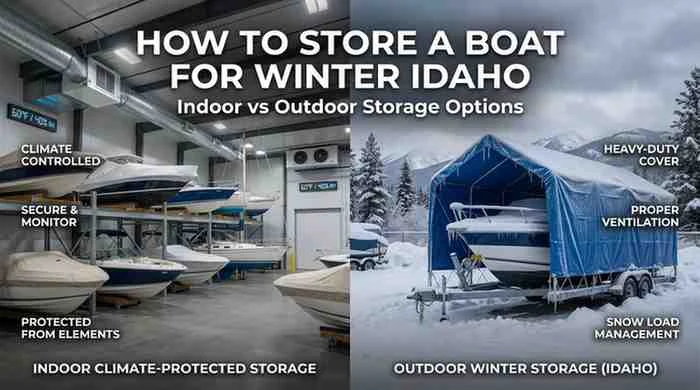
Should You Choose Indoor or Outdoor Boat Storage in Idaho?
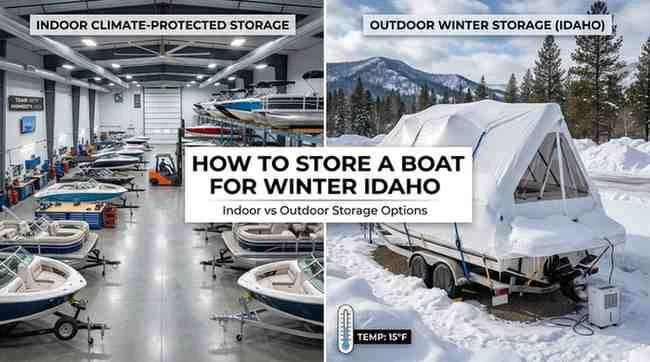
For Idaho winters specifically, indoor or covered storage is the recommended choice for any boat owner who wants maximum protection — the combination of snow loads, freeze-thaw cycles, and UV exposure during storage makes outdoor-only storage a higher-risk option.
| Feature | Indoor Storage | Covered Storage | Outdoor Storage |
|---|---|---|---|
| Weather protection | Maximum — fully enclosed | Strong — roof, open sides | Minimal — boat cover only |
| Snow load protection | Complete | Complete | Depends on cover |
| UV protection | Complete | Partial | Depends on cover |
| Rodent and pest risk | Low | Low-medium | Higher |
| Security | Highest | Good | Variable |
| Cost | Highest | Moderate | Lowest |
| Accessibility | By facility hours or 24/7 | Often 24/7 | Typically 24/7 |
| Best for | High-value boats, long storage | Most Idaho boat owners | Budget storage, mild winters |
For Clearwater Valley boat owners, Elk Country Storage Co. offers vehicle storage options including large unit bays at the Kamiah and Kooskia locations — sized for boats, trailers, and watercraft that need secure off-season storage in a maintained facility. Units up to 10×30 accommodate most recreational watercraft. All rentals are month-to-month with no deposit required, so you pay only for the months your boat is in storage.
What Type of Boat Cover Is Best for Idaho Winters?
For outdoor or covered storage in Idaho, a fitted, marine-grade canvas or polyester boat cover specifically designed for your boat model is the minimum acceptable protection. Shrink wrap is the superior option for maximum weather sealing.
Fitted Canvas or Polyester Covers
Purpose-built boat covers are manufactured to fit specific boat models and create a sealed envelope over the hull and deck. Key features for Idaho winter use:
- Waterproof rating: Look for covers rated at 600 denier or higher for heavy-duty protection
- UV resistance: Prolonged winter sun exposure degrades cheaper cover materials
- Venting: Essential — covers without ventilation trap moisture inside, creating worse mold conditions than no cover at all
- Tie-down straps and buckles: Proper fastening prevents wind from lifting or shifting the cover
Shrink Wrap
Shrink wrap — professionally applied marine shrink wrap — creates a fully sealed, tight-fitting enclosure around the boat. It’s the most weather-resistant option short of indoor storage, and it eliminates the flapping, shifting, and water pooling that even good canvas covers can experience in heavy snow.
Shrink wrap must be applied professionally to include interior ventilation. A shrink-wrapped boat without ventilation will develop severe mold from trapped interior moisture.
What to Avoid
- Standard canvas tarps — they pool water, trap moisture, shift in wind, and provide inadequate UV protection
- Generic “universal fit” covers — they don’t seal properly and allow water and snow infiltration
- Any cover without ventilation — moisture accumulation inside an unsealed cover causes more damage than no cover in some cases
How Should You Store and Maintain a Boat Battery During Winter?
Remove the boat battery before winter storage — leaving it installed in a cold, unattended boat is one of the most reliable ways to destroy it before spring.
Why Battery Removal Matters
Marine batteries self-discharge at approximately 1% per day at room temperature, and faster in cold conditions. A fully charged battery stored in freezing temperatures can survive the winter intact. A discharged battery in freezing temperatures will freeze solid — physically expanding and cracking the battery case, destroying the cells permanently.
Proper Battery Storage Steps
- Remove the battery from the boat before the first hard freeze
- Clean the terminals with a baking soda and water solution to remove corrosion
- Fully charge the battery before storage
- Store in a cool (not freezing) dry location — a garage shelf or indoor storage space is ideal
- Connect to a quality trickle charger or battery maintainer (smart charger) that will maintain charge without overcharging throughout the winter months
- Check the charge level monthly if not on a maintainer
A properly maintained marine battery stored this way will begin spring with full capacity. A battery left in a frozen boat will often need immediate replacement before the first spring launch.
How Can You Prevent Mold, Mildew, and Moisture Damage?
Mold and mildew in a stored boat are caused by trapped moisture combined with organic material — food residue, upholstery off-gassing, and humid air sealed inside an enclosed space. Prevention requires both thorough cleaning and active ventilation.
Ventilation Strategies
- Leave all interior locker doors, cabinet doors, and compartment hatches slightly open during storage to allow air circulation
- Use a boat cover or shrink wrap with proper ventilation ports — never seal a boat completely airtight
- For enclosed cabins, small electric dehumidifiers (if power is available at the storage location) dramatically reduce interior moisture levels
- Vent ports in shrink wrap should be installed by the professional applying the wrap
Moisture Absorbers
- Place moisture-absorbing products (calcium chloride-based products or desiccant bags designed for marine use) in the cabin, storage compartments, and any enclosed spaces
- Replace them partway through a long storage season — they become saturated and ineffective once full
Interior Cleaning
Mold cannot grow on a surface that provides no organic material. Thorough cleaning — vacuuming upholstery, wiping all surfaces with a marine mildew-resistant cleaner, and removing all organic materials (food, bait, fishing rags) — eliminates the substrate mold needs to take hold.
What Are the Most Common Boat Storage Mistakes?
| Mistake | Potential Damage | Prevention |
|---|---|---|
| Skipping engine winterization | Cracked block, seized cylinders, corroded internals — thousands in repairs | Complete full engine winterization before first freeze |
| Leaving water in systems | Cracked hoses, pump housings, fittings, and plumbing components | Drain all systems completely; use marine antifreeze |
| Ignoring battery maintenance | Dead or frozen battery, requiring replacement before spring launch | Remove battery, store indoors, connect to a maintainer |
| Poor boat cover selection | Water infiltration, mold, snow load damage, UV degradation | Use fitted marine cover or shrink wrap with proper ventilation |
| Improper storage location | Weather damage, theft, vandalism, rodent infestation | Choose indoor, covered, or secured facility storage |
| Leaving fuel untreated | Varnished injectors, clogged carburetors, gummed fuel lines | Add marine fuel stabilizer, run through entire system |
| Skipping oil change | Internal corrosion from acidic used oil sitting in engine for months | Change oil and filter before storage, not in spring |
What Is the Ultimate Winter Boat Storage Checklist?
Work through this checklist before your boat goes into storage for the Idaho winter:
Cleaning and Inspection
- Wash hull exterior with marine soap; apply wax or protectant
- Clean and inspect all hardware — apply corrosion inhibitor to metal components
- Inspect hull for cracks, blisters, or damage
- Clean interior thoroughly — vacuum upholstery, wipe all surfaces with mildew-resistant cleaner
- Remove all food, beverages, fishing gear, cushions, and loose equipment
- Leave locker and cabinet doors slightly open for ventilation
Fuel System 7. Add marine-grade fuel stabilizer to tank 8. Run engine 10+ minutes to circulate stabilizer through entire fuel system 9. Top off the fuel tank to minimize condensation space
Engine Winterization 10. Change engine oil and oil filter 11. Change lower unit or sterndrive gear lube — inspect for water contamination 12. Flush cooling system with fresh water 13. Treat raw water cooling system with marine antifreeze 14. Fog engine cylinders with fogging oil 15. For outboards: drain motor completely, tilt to drain, then store tilted up
Freshwater and Plumbing Systems 16. Drain freshwater tanks, water heater, and all plumbing lines 17. Flush system with propylene glycol marine antifreeze 18. Drain livewells, baitwells, and bilge — leave drain plugs out during storage 19. Remove the bilge drain plug and store it inside the boat (not in the boat — next to the ignition or in a visible location as a reminder to reinstall before launch)
Electrical and Battery 20. Remove and fully charge the battery 21. Clean terminals; connect to trickle charger or maintainer for storage 22. Remove or cover all electronics — fish finders, GPS, stereo — and store indoors
Cover and Storage 23. Apply fitted marine cover or arrange shrink wrap with proper ventilation 24. Place moisture absorbers in cabin and enclosed compartments 25. Select storage location — indoor, covered, or secured outdoor facility
How Might an Idaho Boat Owner Prepare a Fishing Boat for Winter?
Consider a typical scenario: a Clearwater Valley angler who runs a 20-foot aluminum fishing boat on the Clearwater and Snake Rivers through the steelhead season, wrapping up in late November as water temperatures drop and winter sets in.
Initial inspection: After the last fishing trip of the season, the owner runs the boat out of the water, inspects the hull for any dings or damage from rocky river bars, and notes a small crack in the transom drain plug housing that needs repair over winter.
Cleaning: The boat is washed completely — hull, deck, storage compartments, and the livewell — with marine soap. Upholstery is vacuumed and wiped down. All fishing gear, tackle boxes, and loose equipment are removed and stored in the garage.
Winterization: Fuel stabilizer is added to the tank and the outboard is run on the flush port for 15 minutes to circulate it. The lower unit gear lube is drained — the owner notes a slight milky color indicating minor water intrusion and makes a note to have the seals inspected before spring. Fogging oil is applied per the outboard manual. The cooling system is flushed and the motor is tilted to drain completely.
Battery: The marine battery is pulled, charged to full, and connected to a Battery Tender in the garage.
Storage: The boat is stored in a 10×30 unit at a local storage facility, out of the snow and weather entirely. A fitted cover is placed over it inside the unit for additional dust protection. Moisture absorbers are placed in the bow and stern compartments.
Spring readiness: In March, before the spring steelhead season, the owner reinstalls the battery, adds fresh fuel, has the lower unit seals inspected and replaced, repairs the transom drain housing, and launches two weeks into the season with a boat in the same condition it was stored in — not worse.
For Clearwater Valley boat owners looking for the same kind of secure, accessible off-season storage, the vehicle storage options at Elk Country Storage Co. — with units up to 10×30, 24/7 gate access, and month-to-month rentals with no deposit — offer exactly this kind of practical solution. Our storage unit size guide can help you determine what size bay fits your specific boat and trailer configuration.
Frequently Asked Questions: How to Store a Boat for Winter in Idaho
How do you store a boat for winter in Idaho? Store a boat for winter in Idaho by completing full engine winterization before the first freeze, stabilizing the fuel system, draining all freshwater plumbing, removing and maintaining the battery, applying a quality marine cover or shrink wrap, and placing the boat in secure indoor, covered, or outdoor storage. The full process should be completed by mid-October in most of central and northern Idaho.
Do boats need to be winterized in Idaho? Yes. Idaho winters regularly produce temperatures well below freezing, and any water left in an engine’s cooling system, freshwater plumbing, or bilge will freeze and expand with enough force to crack components. Winterization is not optional in Idaho — it’s the difference between a working boat in spring and a significant repair bill.
Is indoor boat storage worth the cost in Idaho? For most Idaho boat owners, yes. Indoor storage eliminates snow load damage, UV degradation, freeze-thaw moisture cycling, and security risks. The cost difference between indoor and outdoor storage is typically recouped in one avoided repair — particularly for higher-value watercraft stored over multiple seasons.
Can I store my boat outside during an Idaho winter? You can, but it requires a quality fitted marine cover or professional shrink wrap with proper ventilation, a fully completed winterization procedure, and a secure, maintained storage location. The risks of moisture intrusion, snow load damage, and UV degradation are meaningfully higher than indoor or covered storage.
What happens if I don’t winterize my boat in Idaho? Skipping winterization in Idaho typically results in freeze damage to the engine cooling system, cracked freshwater plumbing, a destroyed battery, and varnished fuel system components. Repair costs for freeze-damaged engine blocks and manifolds routinely exceed $2,000–$5,000. Full winterization costs a fraction of that in time and materials.
Should I remove the boat battery for winter storage? Always. Marine batteries discharged in freezing temperatures freeze solid and are destroyed. Remove the battery, store it indoors, charge it fully, and connect it to a quality battery maintainer throughout the winter. A properly maintained battery begins spring at full capacity.
What type of boat cover works best in Idaho winters? A purpose-built, fitted marine canvas or polyester cover rated at 600 denier or higher, with built-in ventilation. Professional shrink wrap is the superior option for outdoor storage — it creates a fully sealed, snow-shedding enclosure while allowing interior ventilation. Generic tarps are inadequate for Idaho winter conditions.
How long can a boat remain in storage? A properly winterized and stored boat can remain in storage indefinitely without degradation. Annual checks — inspecting for moisture intrusion, pest activity, cover condition, and battery charge — are good practice for any boat stored longer than six months.
What maintenance should be done before spring launch? Before spring launch: reinstall and test the battery, add fresh fuel, change the engine oil if not done before storage, inspect all belts and hoses, test the bilge pump, reinstall the drain plug, check fire extinguisher and safety equipment dates, and test the engine on the hose before launching.
How do I prevent mold in a stored boat? Clean the interior completely before storage — vacuum upholstery, wipe all surfaces, remove all organic material. Leave interior compartment doors slightly open for airflow. Use a boat cover or shrink wrap with proper ventilation (never seal airtight). Place moisture-absorbing products in the cabin and enclosed spaces.
Final Thoughts on How to Store a Boat for Winter in Idaho
Proper winter storage is one of the highest-return habits a boat owner can build — the difference between arriving at the spring launch ramp with a boat in excellent condition and arriving with one that needs a week of repairs before it’s on the water.
The steps aren’t complex, but they need to be completed in the right sequence and before Idaho’s temperatures drop below freezing. Engine winterization protects the components most vulnerable to catastrophic freeze damage. Fuel stabilization protects the injection and carburetion systems from a full off-season of degradation. Battery removal and maintenance protects the electrical system. And the right storage — indoor or covered whenever possible — protects everything else.
For Clearwater Valley boat owners who want a secure, accessible, and practical off-season storage solution, Elk Country Storage Co. is here with large-bay vehicle storage at both Kamiah and Kooskia, month-to-month terms, no deposit required, and 24/7 gate access so you can check on your boat whenever you need to.
If you found this guide useful, share it with a fellow boater who’s heading into their first Idaho winter — and feel free to reach out if you have questions about storage options in the Clearwater Valley.
📞 Call or text: (208) 630-3753 🌐 Reserve storage: elkcountrystorageco.com/reserve
Related Resources from Elk Country Storage Co.:
- Vehicle Storage — Secure off-season storage for boats, RVs, trailers, and more
- Storage Unit Size Guide — Find the right bay for your boat and trailer
- No-Deposit Storage — Start your seasonal storage rental without upfront costs
- How to Store Fishing Gear in Winter — Off-season care for rods, reels, waders, and tackle
- Month-to-Month Storage — Flexible seasonal rental terms with no long-term contract