
Introduction
Hunting season ends fast. One week you’re in the field at first light, the next you’re back to regular life with a pile of camo, base layers, scent-control gear, and outerwear heaped in the corner of the garage. And most hunters let it sit there — dirty, compressed, exposed — until September rolls around again and the scramble begins.
Here’s the problem: improper off-season storage doesn’t just create inconvenience. It actively damages your investment, degrades your scent-control system, and hands deer, elk, and other game every advantage they already have over you. Mildew embeds in fabric and can’t always be washed out. Human odor compounds left to marinate for months are nearly impossible to fully neutralize. Moisture works its way into seams and insulation and shortens the lifespan of gear that cost serious money to buy.
Knowing how to store hunting clothes correctly in the off-season is one of the most overlooked skills in a hunter’s preparation routine — and one of the highest-return habits you can build. For Clearwater Valley hunters who take elk, deer, and steelhead seriously, this guide covers every step: how to clean and prep your clothing before storage, the best containers and methods to use, how to maintain scent control through months of storage, and what to do when home storage isn’t the right answer.
By the end, you’ll have a clear, practical system for off-season hunting clothes storage that sets you up for a cleaner, more effective hunting season before it even starts.
Step 1: Wash Everything Before It Goes Into Storage — the Right Way
The single most important rule of hunting clothes storage is deceptively simple: never store dirty hunting clothes. Field sweat, blood, food odors, campfire smoke, and environmental scents embedded in unwashed fabric are exactly what you don’t want compounding for six to nine months in a sealed container.
But washing hunting clothes isn’t the same as washing regular laundry. The wrong detergent can do more harm than good.
Use a Scent-Eliminating or Unscented Detergent
Standard laundry detergents contain UV brighteners, perfumes, and chemical agents that are designed to make clothes smell clean to a human nose. To a whitetail deer, elk, or mule deer, those same chemicals are an immediate red flag. UV brighteners in particular make treated fabric glow under the blue-spectrum light animals see in dawn and dusk conditions — which is exactly when you’re most likely to be hunting.
Wash all hunting clothes in a scent-eliminating or field-appropriate unscented detergent. These are specifically formulated without UV brighteners or artificial fragrances, and they neutralize odor-causing bacteria in the fabric rather than masking them with perfume. Several outdoor-oriented brands make these, and they’re widely available at hunting supply stores.
Wash Inside Out
Turn all base layers, mid-layers, and outer camo inside out before washing. This increases agitation on the inner surface where body odor and sweat are most concentrated.
Run an Extra Rinse Cycle
Detergent residue left in fabric fibers carries its own odor signature. An extra rinse cycle after the main wash removes that residue and leaves the fabric as neutral as possible before storage.
Air Dry — Not Machine Dry
Dryer sheets and dryer residue are scent nightmares. Air dry all hunting clothes outdoors if possible, which also allows environmental odors like fresh air, grass, and earth to naturally work into the fabric. If outdoor drying isn’t practical, dry indoors away from kitchen, bathroom, or other odor-heavy areas.
Step 2: Inspect Every Piece Before Storage
Once everything is clean and dry, do a thorough inspection before anything goes into a bin or bag. Off-season storage is the right time to deal with wear and damage — not the week before opening day when you don’t have time to fix anything.
Check for:
- Tears, abrasion damage, or worn-through areas on seat and knee panels
- Zipper function on all jacket, pant, and pocket zippers — a stuck zipper in the field is a genuine problem
- Worn or delaminating waterproof membranes on outer shells
- Damaged insulation — any cold spot or flat area in an insulated layer means the fill has shifted or compressed beyond recovery
- Button and snap condition on any outerwear with closures
- Cuff, hem, and gaiter elastic that has lost its tension
- Seam tape delamination on any waterproof-breathable garments
Repair what can be repaired before storage. Garments with small tears can often be field-repaired with seam tape or iron-on patches. For more significant damage, contact a repair service or the original manufacturer — many outdoor brands offer warranty repair programs.
Step 3: Choose the Right Storage Method for Hunting Clothes
How you store hunting clothes is almost as important as how you wash them. The goal is a sealed, low-odor, moisture-stable environment that maintains scent neutrality throughout the off-season.
Option 1: Airtight Plastic Storage Bins
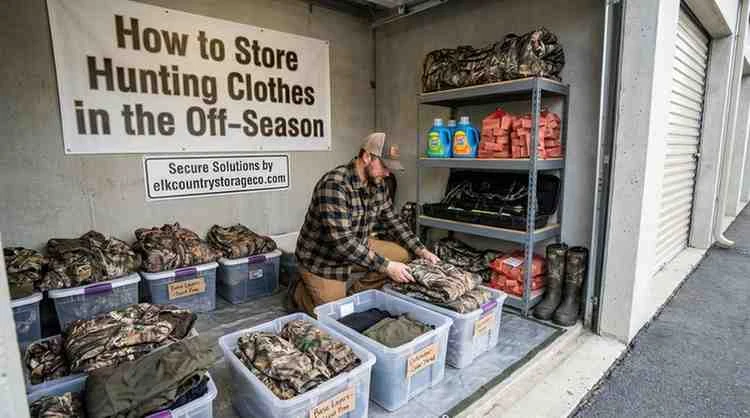
Heavy-duty airtight plastic bins with gasket-sealed lids are the gold standard for hunting clothes storage. They’re impermeable to outside odors — gas fumes, food smells, cleaning chemicals, whatever else lives in a garage or storage unit — and they prevent moisture intrusion from the surrounding environment.
Choose bins that are large enough to fold (not cram) garments without excessive compression. Overstuffing a bin compresses insulation, permanently degrades loft, and creates creases in waterproof membranes that can crack over time.
Tips for using airtight bins:
- Wipe the inside of the bin with an unscented cloth before loading
- Add cedar chips, earth-scented wafers, or activated charcoal to absorb any residual ambient odor inside the bin
- Do not add synthetic air fresheners or scented products of any kind
- Label the bin on the outside with contents and the season it was last used
Option 2: Vacuum-Sealed Storage Bags
Vacuum-sealed bags compress clothing significantly, which is useful for maximizing storage space. They’re also effective at blocking outside odors from penetrating stored fabric. For off-season hunting clothes storage, vacuum-seal bags offer two meaningful advantages: extreme odor isolation and significant space savings.
Important caveats for vacuum sealing hunting clothes:
- Do not vacuum seal insulated garments long-term. Down and synthetic fill compressed for months can lose loft that doesn’t fully recover. Reserve vacuum sealing for non-insulated base layers, lightweight mid-layers, and accessories.
- Use for medium-term storage only. Vacuum-sealed bags are excellent for six to eight months but are better than airtight bins only when space is a constraint.
- Store sealed bags inside an airtight bin for double-layer odor protection.
Option 3: Scent-Free Storage Bags
Several hunting-specific brands produce large scent-proof bags made from materials that block odor transmission in both directions — keeping outside smells out and keeping the garment’s neutralized state intact. These range from simple sealed bags to sophisticated multi-layer systems with activated carbon components.
Scent-proof storage bags are particularly worth the investment for high-end outer layers where maintaining scent neutrality from storage to field matters most. They’re also useful for transport — if you’re driving to a hunting area and want your clothes to arrive as scent-clean as possible.
Step 4: Control Moisture and Humidity in Storage
Moisture is the enemy of off-season clothing storage. Even in an airtight container, garments that weren’t completely dry before storage can develop mildew. And in storage environments with high ambient humidity — garages, barns, or non-climate-controlled units in Idaho’s shoulder seasons — moisture can work into sealed containers over time.
Add Silica Gel Desiccant Packets
Silica gel packets absorb moisture from the air inside a sealed container, preventing the humidity accumulation that creates mildew conditions. Include several packets in each storage bin, particularly if the storage location experiences humidity changes. They’re inexpensive, reusable (dry them out in a low oven to recharge), and an easy insurance policy against mildew damage.
Inspect for Mildew Before Sealing
Before sealing any bin, take a final close look and smell-check of every garment. Mildew in early stages can be detected by a faint musty smell before it becomes visible. If anything smells off, rewash and completely re-dry before sealing.
Choose Your Storage Location Carefully
Where you store hunting clothes matters as much as what you put them in. Garages in the Clearwater Valley get hot in summer and cold in winter — and temperature swings drive humidity changes that challenge even good containers over time.
For hunters with high-value technical hunting clothing, climate-controlled storage provides a stable temperature and humidity environment year-round that dramatically reduces the risk of mildew, fabric degradation, and odor contamination.
Step 5: Organize Your Hunting Clothes Storage System
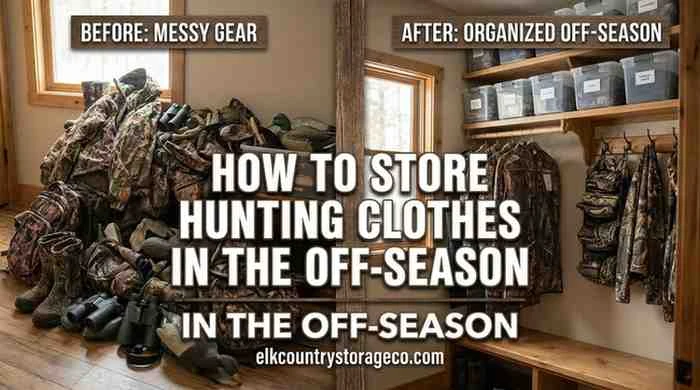
Good organization at storage time means dramatically less stress at the start of the next season. A well-organized hunting clothes storage system should make it possible to pull out exactly what you need for opening week without unpacking everything to find it.
Organize by System Layer
Hunting clothing works in a layered system — base layer, mid-layer, insulating layer, outer shell. Storing by system keeps your kit together and makes packing for any hunt fast and logical.
- Bin 1: Base layers (tops and bottoms, all weights)
- Bin 2: Mid-layers and fleece (quiet fabric pieces, soft-shell panels)
- Bin 3: Insulating layers (puffy jackets, insulated bibs, vest)
- Bin 4: Outer shells (waterproof jacket, rain bibs, packable layers)
- Bin 5: Accessories (gloves, face masks, hats, gaiters, boot liners)
Include a Contents List in Each Bin
A simple card inside the lid listing every item in the bin speeds up retrieval and helps you identify anything that didn’t make it back from the field. It also makes pre-season gear checks straightforward — open the bin, check against the list, identify what needs replacement.
Photograph Your Storage Setup
A quick photo of your organized hunting clothes before the lids go on is an easy inventory record. Cross-referenced with your gear checklist, it tells you exactly what you have and what condition it was in at the end of the season.
For hunters managing a larger kit that includes firearms, optics, calls, decoys, and equipment alongside clothing, our guide on what size storage unit for hunting gear covers how to choose the right unit to hold everything together in one organized, accessible space.
Can Hunting Clothes Be Stored in a Garage?
The garage is the default storage location for most hunters — and for light off-season loads with basic bins, it can work. But the garage environment creates real challenges for serious scent-control storage:
Temperature extremes. Idaho garages get genuinely hot in summer. Heat accelerates the breakdown of synthetic fabrics, waterproof membranes, and elastic components. It also drives off residual moisture in ways that can stress fabric fibers over time.
Ambient odors. Gasoline, oil, paint, fertilizer, cleaning chemicals, and vehicle exhaust are all concentrated in most garages. Even the best airtight bin will eventually absorb some of that environment’s odor character through repeated openings. For serious scent-control hunters, this is a meaningful concern.
Rodents. Rural Idaho garages are rodent-accessible environments. Mice and squirrels have no respect for your $400 merino base layer, and a single nesting event can destroy a season’s worth of carefully stored clothing.
Humidity fluctuations. Garages don’t regulate humidity. Wet vehicles, open doors in rain, and seasonal humidity changes all create conditions that challenge moisture management inside storage bins.
When Home Storage Isn’t Enough: Self Storage for Hunting Clothes
For hunters with significant investments in technical clothing — or who want to maintain rigorous scent-control discipline through the off-season — a dedicated self-storage unit offers advantages that garage storage simply can’t match.
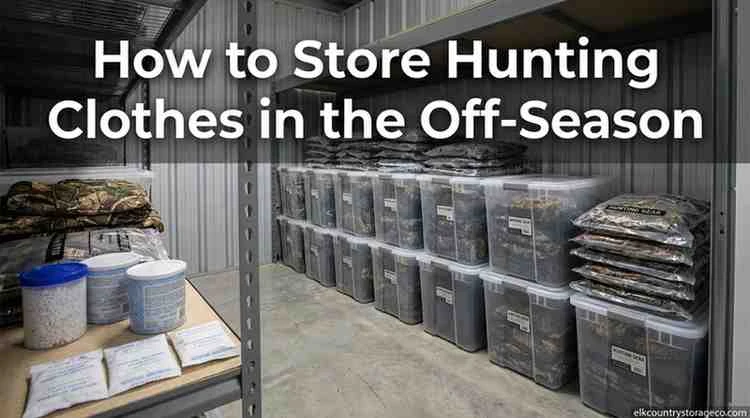
Climate-controlled storage at Elk Country Storage Co. provides a stable temperature and humidity environment, eliminating the seasonal extremes that degrade fabric over months. A dedicated storage unit also keeps your hunting clothes entirely separate from household odors, garage chemicals, and any other scent sources that might compromise your neutralization efforts.
For Clearwater County hunters who take elk and deer hunting seriously, the investment in proper scent-controlled storage is small relative to the cost of the clothing itself — and compared to the cost of a compromised hunt.
Our complete guide on how to store camping gear in winter covers related storage prep for outdoor equipment that often lives alongside hunting clothes, and the fishing gear winter storage guide applies many of the same principles to another major seasonal gear category.
Off-Season Hunting Clothes Storage: What Not to Do
Knowing what to avoid is as useful as knowing what to do right. Here are the most common off-season storage mistakes Clearwater Valley hunters make — and why they matter:
Storing clothes still damp from the last day of season. Even slightly damp fabric in a sealed container is a mildew incubator. One season’s laziness can write off a $200 base layer with embedded mildew that no amount of washing will fully remove.
Using regular laundry detergent. Fragrances and UV brighteners in standard detergents contaminate scent-neutral fabric and make you more visible to game in low light. The first wash of the new season won’t fully remove a full off-season of brightener build-up.
Storing in cardboard boxes. Cardboard absorbs and holds moisture, transfers the smell of the box itself to stored items, and provides zero protection against rodents. Always use hard-sided plastic bins with secure lids.
Adding scented cedar products. Natural cedar has its own strong odor. While it repels insects and some rodents, the cedar scent will transfer to your hunting clothes. Use unscented desiccant packets or activated charcoal instead.
Storing hunting clothes with everyday clothing or household items. Kitchen odors, laundry detergent smells from regular clothes, and general household scent will work their way into hunting gear stored in the same bin or location over months.
Compressing insulated garments long-term. Down and synthetic fill permanently loses loft when compressed for extended periods. Store insulated pieces loosely in appropriately sized bins.
Pre-Season Checklist: Getting Hunting Clothes Out of Storage Right
Just as important as how you store your hunting clothes is how you bring them back out. A pre-season routine that takes less than an hour sets your scent-control system up for the entire hunting season.
Before opening day, work through this checklist:
- [ ] Open bins outdoors or in a fresh-air environment — not in the garage
- [ ] Air out all garments away from household odors before wearing
- [ ] Run all pieces through one wash cycle with scent-eliminating detergent
- [ ] Inspect for any mildew, odor, or damage that developed in storage
- [ ] Test all zippers, closures, and adjustable components
- [ ] Recharge any activated carbon components per manufacturer instructions
- [ ] Restock desiccant packets for the new storage season after hunting ends
Frequently Asked Questions: How to Store Hunting Clothes
Should hunting clothes be washed before storage? Yes, always. Washing hunting clothes before storage removes field odors, bacteria, and scent compounds that would compound over months in a sealed container. Use a scent-eliminating or unscented detergent without UV brighteners and air dry before packing.
Should hunting clothes be vacuum sealed? Vacuum sealing in idaho is effective for non-insulated base layers and lightweight pieces where scent isolation and space savings are priorities. Avoid vacuum sealing down or synthetic insulated garments long-term — compression permanently reduces loft and warmth.
How do you keep hunting clothes scent free in storage? Store in airtight bins after washing with scent-eliminating detergent. Add activated charcoal or unscented desiccant packets inside the bin. Keep bins away from household chemicals, vehicle exhaust, food storage, and other strong odor sources. Climate-controlled storage eliminates ambient garage odors entirely.
Can hunting gear be stored in a garage? A garage can work for basic storage with proper airtight bins. The main risks are ambient chemical odors, temperature extremes, rodent access, and humidity fluctuations. For serious scent-control hunters or high-value technical clothing, a climate-controlled storage unit is the more reliable option.
Do I need climate-controlled storage for hunting gear? For technical hunting clothing — waterproof-breathable shells, insulated layers, and high-end base layers — climate-controlled storage protects against heat, cold, humidity, and ambient odors that garage storage cannot fully prevent. It’s especially worth considering for collections that represent a significant financial investment.
How do you prevent mildew on hunting gear in storage? Ensure everything is completely dry before sealing. Add silica gel desiccant packets to every bin. Store in a dry, stable environment. For high-humidity storage locations, climate-controlled storage significantly reduces mildew risk.
What containers are best for hunting clothes storage? Heavy-duty airtight plastic bins with gasket-sealed lids are the best option. They protect against odor intrusion, moisture, and pests. Avoid cardboard boxes, which absorb moisture and transfer odor to stored items.
How long can hunting clothes stay in storage? Properly washed, dried, and sealed hunting clothes stored in airtight bins can remain in storage for a full off-season — typically six to nine months — without significant degradation if moisture is controlled and the storage environment is stable.
Storing More Than Just Clothing: A Complete Off-Season Hunting Setup
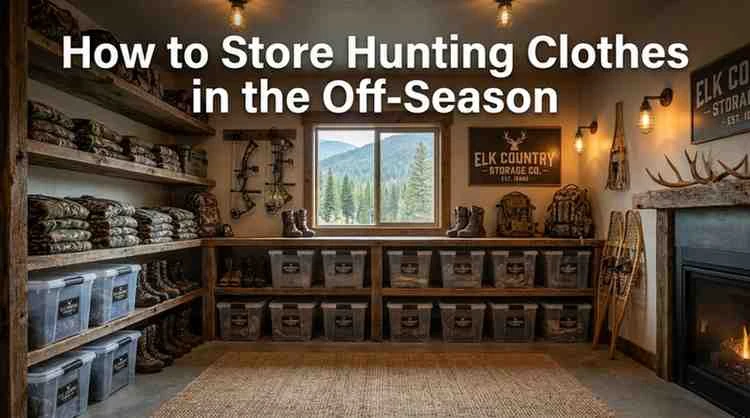
Hunting clothes are only part of an off-season storage picture. Most serious hunters have a full kit that goes into storage alongside clothing: optics, archery equipment, firearms accessories, calls, decoys, trail cameras, tree stands, and safety equipment.
Keeping all of it organized in one dedicated, secure location — rather than scattered across a garage, basement, and barn — makes pre-season prep dramatically faster and ensures nothing critical gets missed.
Elk Country Storage Co. offers unit sizes from 5×5 to 10×30 specifically suited for hunting gear storage of any scale. The guide on what size unit works for hunting gear gives specific size recommendations based on the scope of your setup — from a minimalist bowhunter to a full-scale elk camp operation.
And when hunting season overlaps with the end of camping and fishing season, our guides on how to store camping gear in winter and how to store fishing gear in winter provide the same kind of systematic prep approach for the rest of your seasonal outdoor kit.
Why Clearwater Valley Hunters Trust Elk Country Storage Co.
The Clearwater Valley is some of Idaho’s best hunting country — elk in the high drainages, whitetail along the river bottoms, mule deer on the breaks above Kooskia and Kamiah. The hunters who work this country take their equipment seriously, and equipment deserves storage that matches that commitment.
Elk Country Storage Co. serves hunters across Kamiah, Kooskia, Orofino, Harpster, Stites, Grangeville, and the greater Clearwater Valley with:
- No deposit required — Start your off-season storage rental without tying up money you need elsewhere
- Month-to-month rentals — Rent through the off-season and stop when hunting season starts
- 24/7 gate access — Access your gear at any hour, any day of the year
- Climate-controlled storage units — Stable temperature and humidity to protect technical clothing, optics, and electronics
- Unit sizes from 5×5 to 10×30 — Enough range to store a single bin of clothing or an entire elk camp’s worth of gear
- Two convenient locations — Kamiah and Kooskia, both accessible from throughout the Clearwater Valley
For Clearwater County hunters who want their gear ready when the season opens — not scrambled, damp, or contaminated with garage odors — a dedicated storage unit is one of the best pre-season investments you can make.
Conclusion
The effort you put into how to store hunting clothes in the off-season pays dividends every time you step into the field. Clean, scent-neutral, properly organized clothing doesn’t happen by accident — it’s the result of a storage system that works.
Wash everything with the right detergent. Dry completely before sealing. Use airtight bins with moisture control. Organize by system layer. Keep hunting clothes away from household and garage odors. And when the garage environment isn’t good enough for the investment you’ve made in technical hunting clothing, consider a dedicated storage unit in the Clearwater Valley.
Your hunting clothes are part of your system. Store them like it.
Reserve Your Off-Season Hunting Gear Storage Unit Today
📞 Call or text: (208) 630-3753 📧 Email: elkcountrystorageco@gmail.com 🌐 Reserve online: elkcountrystorageco.com/reserve
Kamiah: 303 Locust Rd, Kamiah, ID 83536 Kooskia: 4689 Hwy 13 South, Kooskia, ID 83539
✓ No deposit required ✓ Month-to-month rentals ✓ 24/7 gate access ✓ Climate-controlled options available
Serving Kamiah, Kooskia, Orofino, Harpster, Stites, Grangeville, Lewiston, and the entire Clearwater Valley, Idaho.
Related Resources from Elk Country Storage Co.:
- What Size Storage Unit for Hunting Gear — Full kit sizing guide for Clearwater Valley hunters
- Climate-Controlled Storage — Protect technical clothing and optics from Idaho’s seasonal extremes
- How to Store Camping Gear in Winter — Off-season prep for outdoor equipment
- How to Store Fishing Gear in Winter — Seasonal storage guide for Clearwater anglers
- Storage Unit Size Guide — Match your gear load to the right unit
- Month-to-Month Storage — Flexible off-season rental terms
- No-Deposit Storage — Start your rental without upfront costs
- Vehicle Storage — Off-season storage for ATVs, trailers, and campers
- Kamiah Storage Units — Units available in Kamiah
- Kooskia Storage Units — Units available in Kooskia
- Reserve a Unit — Start your no-deposit storage rental today