
Introduction
People move to Idaho for a reason. Sometimes it’s the space — the wide-open landscape, the elk country, the rivers that actually run clear. Sometimes it’s the pace — smaller towns, fewer traffic lights, neighbors who wave back. Sometimes it’s a deliberate step away from the cost, congestion, and complexity of wherever they came from. And increasingly, it’s all three at once.
Moving to Idaho — and specifically to the Clearwater Valley communities of Kamiah, Kooskia, and their surrounding area — means stepping into a way of life that rewards preparation. Rural Idaho living is genuinely wonderful, but it operates on its own terms. The infrastructure, the seasons, the community dynamics, and the practical realities of daily life here are different enough from most places that newcomers who do their research in advance settle in faster, with fewer unpleasant surprises.
This guide is written for people who are seriously considering or actively planning a move to the Kamiah and Kooskia area — or to rural central Idaho more broadly. It covers what makes this region worth moving to, what to realistically expect in terms of climate, housing, services, and community, what the moving process itself looks like for long-distance and out-of-state relocations, and how to handle the storage gap that almost every move creates.
By the end, you’ll have a clearer picture of what life in the Clearwater Valley is actually like — and a practical plan for the logistics of getting there.
Why People Are Moving to Idaho — and to the Clearwater Valley Specifically
Idaho has been one of the fastest-growing states in the country for several years running, and for the most part, the people moving here are not coming for the nightlife. They’re coming for space, affordability relative to Pacific Coast markets, a strong sense of community, and access to outdoor recreation that would cost significantly more in fees, crowds, and travel time almost anywhere else.
The Clearwater Valley — the stretch of central Idaho along the Clearwater River and its tributaries, running through communities like Orofino, Kamiah, Kooskia, Grangeville, and Lewiston — draws a specific kind of newcomer. People who want a genuinely rural small-town environment without being entirely disconnected from services. People who hunt, fish, and spend serious time outdoors. Remote workers who’ve realized their job can go anywhere their internet connection does. Retirees looking for low cost-of-living, low crime, and access to a pace of life that larger Idaho cities are increasingly unable to provide as they grow.
If any of those descriptions fit you, the Clearwater Valley is worth a serious look.
What to Know About Moving to Kamiah, Idaho
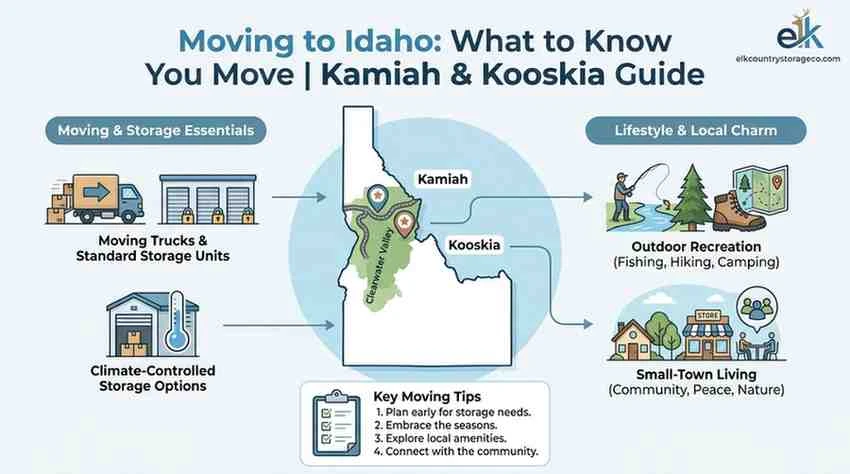
Kamiah sits at the confluence of the Clearwater River and Lawyer Creek in Lewis County. It’s a town of a few thousand people with a Main Street, a school system, basic retail and grocery access, medical services, and the kind of community infrastructure that makes rural Idaho life genuinely livable rather than merely scenic.
The Clearwater River and Outdoor Access
For outdoor-oriented newcomers, Kamiah’s location is hard to beat. The Clearwater River is legendary among steelhead and salmon anglers, and the surrounding drainages offer elk, deer, and upland bird hunting on a scale that most of the country simply can’t match. If your reason for moving to Idaho includes outdoor recreation, Kamiah puts you within minutes of world-class fishing and hours of good hunting ground.
Community Character
Kamiah is a community with deep roots — Native American cultural history, logging heritage, agricultural tradition — and newcomers who arrive with respect for that character tend to integrate well. People here are friendly and genuinely helpful, but the community has seen enough outsiders arrive with strong opinions about how things should be done that patience and humility go a long way in the early months.
Practical Services in Kamiah
For a small town, Kamiah has solid practical services. Grocery, pharmacy, fuel, basic hardware, medical clinics, and schools are all available locally. For larger retail needs — major appliances, specialty supplies, more significant medical services — Lewiston is roughly an hour away. Understanding this dynamic in advance prevents the frustration that catches some newcomers off guard.
What to Know About Moving to Kooskia, Idaho
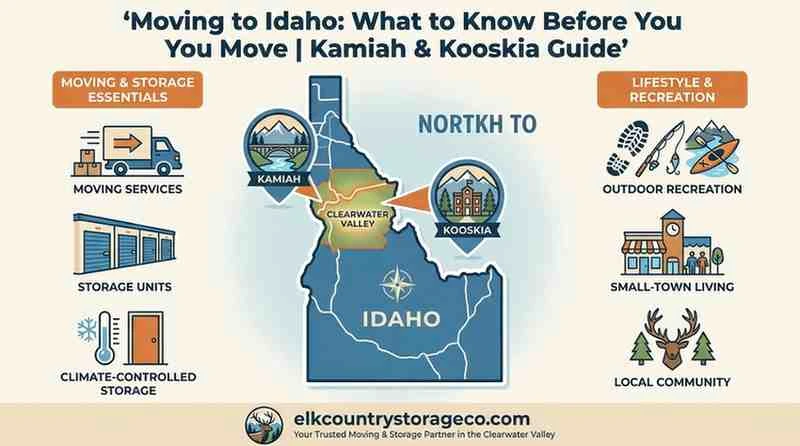
Kooskia sits at the confluence of the South Fork and Middle Fork of the Clearwater River, at the junction of US-12 and Idaho Highway 13. It’s smaller than Kamiah but similarly situated for outdoor access, and it serves as a gateway community for travel deeper into the Idaho wilderness along the Wild and Scenic portion of US-12 toward the Lochsa River corridor.
Gateway to the Wilderness
If access to true wilderness is a priority, Kooskia’s location is exceptional. US-12 along the Lochsa River is one of Idaho’s most spectacular highways and leads to backcountry access points for hiking, fly fishing, and exploration that sees relatively light use compared to better-known Idaho destinations.
Community and Services
Kooskia is a smaller community than Kamiah with corresponding service availability. Basic needs can be met locally, but the same regional service geography applies — Kamiah a short drive to the north, Lewiston an hour or so for larger needs. Many Kooskia residents think of this as a feature rather than a limitation. The relative isolation is part of what drew them here.
Highway 13 Corridor Connection
For newcomers settling between Kooskia and Grangeville along Idaho Highway 13, the South Fork valley communities of Stites and Harpster sit along the route. This corridor has a strong agricultural and ranching character and is home to many of the region’s long-established families.
Idaho’s Climate: What New Residents Need to Be Prepared For
Moving to Idaho from most coastal or southern states means encountering a climate that is genuinely different in ways that matter for daily life, home maintenance, and the seasonal rhythm of the year.
Four Real Seasons
The Clearwater Valley experiences four distinct seasons. Summers are warm and dry — genuinely hot in July and August in the valley bottoms. Falls are stunning, with the larch turning gold across the hillsides through October. Winters bring real cold to the valley, with temperatures regularly dropping below freezing and occasional significant snowfall, though the valley floor typically sees less snow accumulation than higher elevations. Springs are wet and green, with the Clearwater running high through May and June.
What the Climate Means for Your Belongings
If you’re moving from a mild-climate state — California, Oregon, Washington lowlands, Arizona — Idaho’s winter temperatures will be a genuine adjustment for both you and your household contents. Moving trucks are not climate-controlled. Storage units that are not temperature-regulated expose furniture, electronics, and other contents to the same temperature swings as an unheated garage.
For anyone navigating a long-distance relocation to the Clearwater Valley — especially one with a timing gap between when you leave your origin home and when your Idaho home is ready — climate-controlled storage protects wood furniture, electronics, documents, and other temperature-sensitive belongings from Idaho’s seasonal extremes.
Our article on whether you need climate-controlled storage for furniture covers exactly which materials are at risk and when the upgrade is worth the cost.
Idaho Housing: What to Expect in the Clearwater Valley
Idaho’s housing market has changed significantly over the past several years. While the Clearwater Valley remains more affordable than Boise, Coeur d’Alene, or coastal cities, housing inventory in small rural communities is limited and move-in-ready properties sell quickly when they come available.
What This Means for Timing Your Move
The single most important logistical implication of the rural Idaho housing market for newcomers is timing uncertainty. Closing dates get pushed. Properties that seem ready to move into need work before they’re actually livable. New construction timelines extend. Rentals are limited and compete for a small pool of available units.
This is exactly why short-term self storage when moving is one of the most practical tools available to Idaho newcomers. Having your household contents in a secure, accessible storage unit while you finalize housing allows you to be patient rather than pressured into a bad decision. You can take the time the housing situation actually requires without sleeping in an empty house or paying to keep a moving truck for extra days.
Plan for a Storage Gap
If you’re relocating from out of state, build a storage gap into your move plan from the beginning. Assume your household contents will need somewhere to live for anywhere from two weeks to two months between when you leave your origin home and when you’re settled in Idaho. Month-to-month storage with no deposit required means that gap costs only what it actually takes — no long-term commitment, no upfront deposit at an already expensive moving moment.
The Idaho Moving Checklist: Practical Steps Before and After You Arrive
Whether you’re moving from California, Washington, Texas, or anywhere else, relocating to rural Idaho involves a specific set of practical steps that are easy to overlook if you’ve only ever moved within a metropolitan area.
Before You Leave Your Origin State
Notify everyone who needs your new address. Financial institutions, insurance providers, the IRS, Social Security if applicable, subscriptions, voter registration, and any recurring deliveries.
Research Idaho vehicle registration requirements. Idaho requires vehicles to be registered in the state within 90 days of establishing residency. Titles, insurance, and emissions (where applicable) requirements vary by county.
Understand Idaho’s rural delivery limitations. If you’re moving to a property outside a town’s core, confirm whether standard carriers (UPS, FedEx, USPS) deliver to your specific address. Rural Idaho has a meaningful number of properties with PO Box addresses or specific delivery logistics that differ from suburban mail delivery.
Research internet and utility providers for your specific address. In rural areas, satellite internet (including newer low-earth-orbit options) is often the practical choice. Confirm what’s available at your address before committing to any provider.
Arrange moving storage before your arrival date. If there’s any chance your Idaho home won’t be move-in ready on the day your truck arrives, arranging a storage unit in Kamiah or Kooskia in advance prevents a scramble. Reserve a unit online ahead of time so it’s there when you need it.
After You Arrive in Idaho
Establish Idaho residency as quickly as practical. Idaho driver’s license and ID card transfer, voter registration, and vehicle registration all begin the 90-day clock from the date you establish residency.
Introduce yourself to your neighbors. In small rural communities, relationships matter. The neighbors you meet in the first weeks of living somewhere are often the people who will help you when something goes wrong — and in rural Idaho, something always eventually goes wrong. A good relationship with the people around you is a genuine practical asset, not just a nicety.
Get oriented with seasonal rhythms before they catch you off guard. If you arrive in August, the summer feels endless and benign. September changes fast. Have your firewood sorted, your heating system serviced, your vehicle winterized, and your emergency supplies in order before October.
Find your local hardware store, farm supply, and independent businesses. Rural Idaho small businesses are the backbone of community life. Tractor Supply, Murdoch’s, and locally owned hardware stores carry what you need for rural property maintenance in a way that big-box stores often don’t.
Storage Solutions for Idaho Newcomers
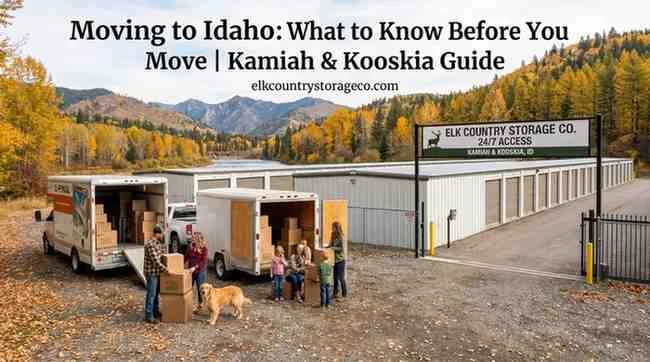
Almost every long-distance move involves a moment — sometimes a day, sometimes a month — when your household contents need somewhere to live that isn’t your origin home or your destination. For newcomers to the Clearwater Valley, Elk Country Storage Co. offers storage solutions designed specifically for the flexibility that moving situations require.
What Moving Families and Individuals Store
Household furniture, appliances, mattresses, boxes, seasonal items, outdoor gear, vehicles, and recreational equipment are all common moving storage loads. The right unit size depends on how much you’re bringing — our storage unit size guide maps out exactly what fits in each unit so you’re not guessing.
Climate-Controlled Storage for Long-Distance Moves
If your household contents are spending weeks or months in storage between your origin state and your Idaho home, climate-controlled storage is the right choice for furniture, electronics, and any belongings sensitive to temperature or humidity. Climate-controlled units at Elk Country Storage Co. are available on the same no-deposit, month-to-month terms as standard units.
Vehicle and Equipment Storage During a Move
If you’re shipping vehicles, bringing recreational equipment, or arriving with a trailer, boat, or RV before your property is ready to store them, vehicle storage options are available at both Kamiah and Kooskia locations.
Flexible Terms Built for Moving Timelines
Moving timelines rarely follow the plan. Month-to-month storage with no deposit required means you pay only for the time you actually need the unit — whether that’s three weeks or three months. No locked-in contract, no deposit sitting in an account while you’re already managing moving costs.
Outdoor Life in the Clearwater Valley: What Awaits You
One of the most consistent things newcomers say after their first year in the Clearwater Valley is that the outdoor access exceeded what they expected — which is saying something, since most people moved here specifically for the outdoor recreation.
The Clearwater River system is one of Idaho’s premier steelhead and salmon fisheries, and the drainages feeding it produce elk, deer, black bear, and upland birds in numbers that would be extraordinary elsewhere. If you’re planning to hunt and fish — and most Clearwater Valley residents do — the combination of tag availability, public land access, and wildlife populations is genuinely exceptional.
For newcomers bringing significant hunting, fishing, and camping gear to Idaho, the off-season storage picture is worth thinking through in advance. Our guides on how to store camping gear in winter, how to store fishing gear in winter, how to store hunting clothes in the off-season, and what size storage unit you need for hunting gear all cover the practical aspects of seasonal gear storage in the Idaho context.
Frequently Asked Questions
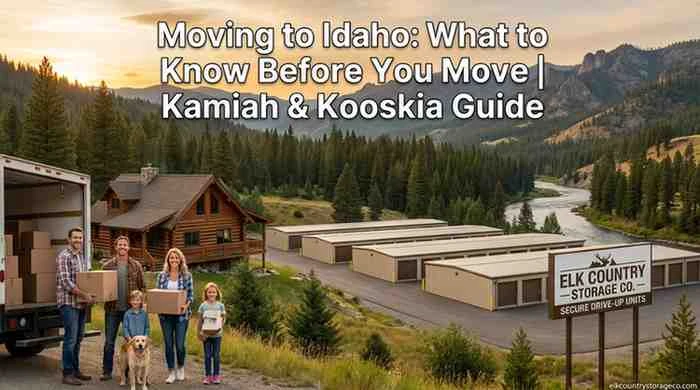
Is the Clearwater Valley a good place to move? For the right person, it’s excellent. If you value rural quiet, outdoor access, low cost of living relative to urban Idaho, tight-knit community, and genuine four-season living, the Kamiah and Kooskia area offers all of that. If you need urban amenities, regular flights, or proximity to a major metropolitan area, the Clearwater Valley will require significant lifestyle adjustment.
What is the cost of living like in Kamiah and Kooskia, Idaho? The Clearwater Valley is generally more affordable than Boise, Coeur d’Alene, or Pacific Coast cities. Housing costs in particular have historically been significantly lower, though prices have risen with broader Idaho market trends. Day-to-day expenses like groceries and fuel are broadly comparable to national averages.
How far is Kamiah from Lewiston, Idaho? Lewiston, Idaho’s second-largest city, is roughly an hour from Kamiah along US-12. Most newcomers find Lewiston serves as their regional center for larger retail, medical specialists, and airport access.
What is internet access like in the Clearwater Valley? Internet availability varies significantly by specific address. Town-center locations in Kamiah and Kooskia typically have cable or DSL options. Rural and outlying properties often rely on satellite internet, including newer low-earth-orbit services that have significantly improved rural connectivity. Confirm availability at your specific address before committing to a provider.
Do I need storage while moving to Idaho? Most long-distance moves to rural Idaho benefit from having a flexible storage option available. Housing timelines shift, closings get delayed, and having a month-to-month storage unit reserved gives your move the flexibility it needs without a large upfront commitment. Reserve online or call (208) 630-3753.
What storage options are available near Kamiah and Kooskia? Elk Country Storage Co. operates two locations — Kamiah at 303 Locust Rd and Kooskia at 4689 Hwy 13 South. Units range from 5×5 to 10×30, with climate-controlled options, 24/7 gate access, no deposit required, and month-to-month rentals.
Is climate-controlled storage available during an Idaho move? Yes. Climate-controlled units are available at Elk Country Storage Co. on the same flexible terms as standard units — important for furniture, electronics, and other belongings moving from milder climates into Idaho’s seasonal temperature range.
Can I reserve a storage unit before I arrive in Idaho? Yes. Reserve a unit online at any time — no need to be local first. Online reservations lock in your unit before your move date so it’s ready when you arrive.
Why Elk Country Storage Co. for Your Idaho Move
When you’re relocating to the Clearwater Valley, storage isn’t a small logistical detail — it’s often the linchpin that makes the whole move workable. A secure, accessible, flexible storage option near your new home gives you the freedom to take your time, make good housing decisions, and settle in without the pressure of a packed truck sitting in the driveway.
Elk Country Storage Co. is locally operated and serves the Clearwater Valley community that new arrivals are joining. Here’s what that looks like practically:
- No deposit required — Your money stays yours at the most expensive moment of your move
- Month-to-month rental terms — Pay only for the months you actually need
- 24/7 keypad gate access — Access your belongings on your schedule, every day of the year
- Unit sizes from 5×5 to 10×30 — The right fit for a few boxes or an entire household
- Climate-controlled options — Protection for furniture, electronics, and belongings sensitive to Idaho’s seasons
- Two Clearwater Valley locations — Kamiah at 303 Locust Rd and Kooskia at 4689 Hwy 13 South
- Online reservations — Reserve your unit before you arrive so it’s ready when you need it
Conclusion
Moving to Idaho — and to the Clearwater Valley specifically — is one of the better decisions many people will make. The landscape is extraordinary, the community is real, and the quality of life available here is genuinely difficult to replicate in more populated parts of the country.
But getting here well requires preparation. Understand the climate before you arrive. Build flexibility into your housing timeline. Plan for the practical realities of rural service geography. Give the community the respect it deserves and the time it takes to become part of it.
And when the move creates a storage gap — because it almost always does — have a plan that doesn’t add financial pressure to an already demanding transition. No-deposit, month-to-month storage in Kamiah or Kooskia gives your relocation the breathing room it needs to go right.
Welcome to Idaho. We hope you love it here.
Reserve Your Moving Storage Unit in the Clearwater Valley
📞 Call or text: (208) 630-3753 📧 Email: elkcountrystorageco@gmail.com 🌐 Reserve online: elkcountrystorageco.com/reserve
Kamiah: 303 Locust Rd, Kamiah, ID 83536 Kooskia: 4689 Hwy 13 South, Kooskia, ID 83539
✓ No deposit required ✓ Month-to-month rentals ✓ 24/7 gate access ✓ Climate-controlled options ✓ Reserve online before you arrive
Serving Kamiah, Kooskia, Orofino, Harpster, Stites, Grangeville, Lewiston, and the greater Clearwater Valley, Idaho.