


Introduction
Here’s the thing about moving clutter: it doesn’t disappear. Everything you skip over, shove in a box, and tape shut gets loaded onto the truck, driven to your new home, unloaded into a new garage or spare room, and unpacked — sometimes months later — into a space you were hoping to start fresh in. You pay to move it, you pay to store it, and then you deal with it anyway on the other end.
The decluttering before moving checklist most people follow is essentially: start too late, sort nothing, pack everything, regret it immediately upon arrival. This guide offers a better approach — one that breaks the job down room by room, gives you a clear four-category sorting framework, and builds in the specific decision points that make decluttering actually manageable rather than overwhelming.
For families and individuals across the Clearwater Valley — Kamiah, Kooskia, Orofino, and the surrounding communities — this is also a guide to using the moving process as an opportunity to right-size what you own before you bring it somewhere new. Whether your new home is bigger, smaller, or simply different in character from your current one, arriving with only what you actually want is one of the best gifts you can give yourself at move-in.
Why Decluttering Before You Pack Saves Time, Money, and Sanity
The case for decluttering first — before a single box gets taped — is straightforward and practical.
Every item you don’t move saves you money. Professional movers charge by weight and volume on most long-distance moves. Even on local moves, fewer boxes means fewer trips, a smaller truck, and less labor. The savings on moving a decluttered home versus a fully packed one can be meaningful.
Unpacking a decluttered home is exponentially faster. Every box that goes into your new home has to be opened, assessed, and put somewhere. Boxes full of items that don’t belong or that you don’t use create decision paralysis in an already-stressful moment. Arriving with only intentional belongings means unpacking is a process of placing, not sorting.
Decluttering reveals what you need to store versus move. Not everything you own needs to travel directly to your new home. Some items — seasonal gear, furniture that doesn’t fit the new space, belongings you’re not ready to part with but won’t need immediately — are natural candidates for a short-term storage unit rather than a moving box. Decluttering first clarifies that line.
Starting fresh matters more than most people admit. There’s a genuine psychological benefit to arriving somewhere new without the accumulation of every previous version of your household. Moving is one of the few natural break points where right-sizing your possessions is both practical and emotionally appropriate.
The Four-Category Sorting Framework
Before you open a single drawer or closet, set up four sorting categories that you’ll apply in every room. Having clear bins, bags, or labeled areas for each category prevents the “I’ll deal with this pile later” problem that derails most decluttering attempts.
Keep — Moving With You
This is everything that’s going to your new home. Be intentional about what earns this category. The test is simple: does this item have a specific place and purpose in your new home, or are you keeping it out of inertia?
Store — Not Moving Now, Not Letting Go
Some belongings aren’t coming to the new home immediately but aren’t ready to be donated, sold, or discarded either. Seasonal gear, furniture that doesn’t fit the new layout, sentimental items that need more time, or belongings in a holding pattern while you make a decision — these go into storage. Month-to-month storage with no long-term commitment is built exactly for this: a temporary home for the things that aren’t quite ready to move with you or leave your life.
Donate, Sell, or Give Away
Functional items with usable life left that simply don’t belong in your next chapter. Local donation centers, online marketplace listings, neighborhood buy-nothing groups, and family and friends are all viable channels. The important rule: set a deadline. Items designated for donation that sit in bags by the front door for three weeks have a way of migrating back into boxes.
Recycle or Discard
Broken items, worn-out clothing, expired products, outdated documents that don’t need retention, and anything that has no useful life left. This category expands significantly in rooms that tend to accumulate paperwork and miscellany — home offices, junk drawers, and garages.
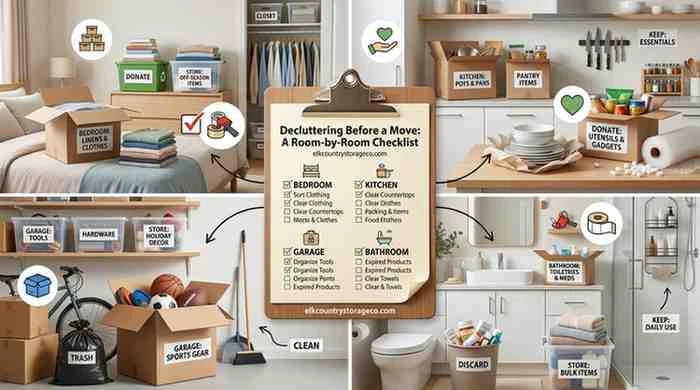
Room-by-Room Decluttering Checklist
Work through the house systematically — one room completed before the next one begins. Partial progress in every room creates chaos. Completed rooms create momentum.
Kitchen
The kitchen is typically the most dense room in a home in terms of items-per-square-foot — and one of the most neglected in decluttering because “I might use it” is kitchen logic’s default setting.
Cabinets and drawers:
- Pull everything out before sorting back in. You cannot accurately assess what you have while it’s still stacked three deep.
- Eliminate duplicates ruthlessly. If you have four spatulas and use one, keep two and donate the rest.
- Anything that hasn’t been used in 12+ months — specialty appliances, single-purpose gadgets, serving pieces for parties you no longer host — donate or sell.
- Assess all food storage containers. Anything without a matching lid, cracked, stained, or warped goes.
Pantry and food storage:
- Discard expired goods completely. Don’t pack and move expired pantry items.
- Donate non-expired, unopened goods you won’t realistically use through a local food bank before your move date.
- Pack shelf-stable pantry items last — they add unexpected weight and take up box space that could go to more useful items.
Small appliances:
- If it doesn’t earn regular counter or cabinet space in your current kitchen, it won’t earn it in the new one. Be honest.
- Test every appliance before deciding to move it. A broken appliance being moved “to get fixed” rarely gets fixed.
What might go to storage from the kitchen: Entertaining pieces, large serving platters, specialized seasonal equipment (canning gear, holiday bakeware), and anything for which there’s no room in the new kitchen but which you’re not ready to part with.
Living Room and Common Areas
Living rooms accumulate slowly — books, décor, electronics, cushions, throw blankets, remote controls for things you no longer own — in ways that are easy to overlook because nothing in the room seems individually significant.
Books: Apply the honest one-pass test: would you actively recommend this book to someone? Would you reread it? If neither, donate it. Most towns have library donation programs or Little Free Libraries. Keep what you’d genuinely reach for.
Décor and display items: Move is the natural time to let go of décor that was “fine” rather than loved. Anything you’re moving because you’ve always moved it rather than because you want it in your new home belongs in the donate category.
Electronics and media: DVDs, old gaming equipment, cables for devices you no longer own, and electronics that “still work” but haven’t been turned on in years are common living room space-consumers. If you wouldn’t buy it again today, don’t pack it.
Furniture: Assess every piece against your new floor plan if you have one. Furniture that doesn’t fit the new space — in scale, style, or literally in dimensions — either sells, donates, or goes into storage while you decide. Don’t move furniture you know won’t work just to move it again six months later.
Bedrooms
Bedrooms are typically where clothing, linens, personal items, and sentimental belongings accumulate — the categories that are both most personal and most likely to be over-retained.
Clothing: The most effective approach is the seasonal sort: pull every item out, sort by season, assess each piece honestly. Keep what fits, what you wore in the past year, and what genuinely represents how you dress now — not how you dressed five years ago or aspire to dress eventually. Donate generously. Clearwater Valley winters demand practical clothing; if your wardrobe is full of items from a previous climate or lifestyle, the move is a natural reset point.
Linens: Most households have 50–100% more linens than they need. Keep two complete sets per bed, two sets of towels per person, and a modest backup. Everything beyond that is excess.
Dressers and nightstands: Clear all drawers completely before assessing. The back of a dresser drawer is where items go to be forgotten for years. Review everything that comes out.
Under-bed storage: The traditional home of things that were last used so long ago they’ve been forgotten. Clear it entirely and apply the four-category framework to everything you find.
Children’s rooms: Involve children appropriately in age-appropriate decisions. Moving is a natural opportunity to donate outgrown toys, books, and clothing to families who can use them — and framing it as generosity rather than loss often helps.
Bathrooms
Bathrooms are smaller rooms with higher clutter density than most people realize — primarily due to personal care products accumulated over time.
Medicine cabinet and under-sink: Discard all expired medications through a proper disposal program (many pharmacies accept them). Discard expired or genuinely unused personal care products. If you haven’t used it in six months, you won’t in the next six.
Towels and linens: Assessed above under bedrooms, but bathroom-specific: keep functional, well-maintained towels in the quantities you actually use. Worn, mismatched, or excess towels can be donated to animal shelters, which often welcome them.
Under-sink storage: Cleaning products, personal care supplies, and miscellaneous items stored here should all be assessed. Don’t move partial bottles of products you don’t use or haven’t opened in months.
Home Office
The home office is the room most likely to contain items that seem important but aren’t — particularly paper.
Documents and files: Sort all paper into three piles: retain, shred, recycle. Documents to retain indefinitely include tax records (keep seven years), legal documents, property records, medical records, and vital documents. Everything else is assessed honestly. Create a clearly labeled folder or binder for essential documents that travels with you — not in a moving box.
Electronics and cables: Test all electronics. Discard or donate non-functional equipment. The cable drawer is almost certainly full of cables for devices you no longer own — go through it completely.
Books and reference materials: Apply the same standard as the living room. Reference books for fields you’re no longer working in, outdated editions, and books kept for appearance rather than use are all candidates for donation.
Office furniture: Assess against your new space. A large desk that dominated a dedicated home office may not work in a multi-purpose room. Think through the new configuration before defaulting to moving everything.
Garage
The garage is the room most households underestimate in the decluttering process — and the one most likely to add significant weight and volume to a move if left unaddressed.
Tools and equipment: Keep what you own and use. Assess duplicates — most households have multiples of common tools accumulated from multiple households over time. Donate quality duplicates to people who need them or sell through online marketplaces.
Seasonal and sports equipment: This is the category most naturally suited to a storage unit rather than the moving truck. Camping gear, hunting equipment, fishing tackle, sports equipment with defined seasons, and recreational gear that won’t be needed immediately in the new home are all candidates for short-term moving storage rather than boxes on the truck.
Our guides on how to store camping gear in winter, how to store fishing gear in winter, how to store hunting clothes in the off-season, and what size storage unit for hunting gear cover prep and organization for all of these gear categories if they’re heading into storage alongside your move.
Hazardous materials: Do not move hazardous materials — partially used paint cans, solvents, pesticides, propane, and similar items. Many municipalities have hazardous waste disposal days or drop-off programs. Check local options and dispose responsibly before your move date.
Vehicles and large equipment: If you’re downsizing to a property with less storage space, vehicles, trailers, ATVs, and recreational equipment may need a vehicle storage solution while you sort out long-term arrangements.
When to Start Decluttering Before a Move
The most common mistake in pre-move decluttering is starting too late. A week before the truck arrives is crisis mode, not decluttering. Here’s a workable timeline:
8+ weeks out: Start with low-urgency areas — garage, basement, attic, spare rooms. These require the most time and generate the most donate/discard volume.
6 weeks out: Work through living areas, home office, and all bedroom closets. This is when you should also arrange storage for the “store” category items — having a unit reserved means you have somewhere to move those items off-site rather than letting them drift back into boxes.
4 weeks out: Kitchen, bathrooms, and final pass through all rooms. Begin packing non-essential items.
2 weeks out: Pack room by room, starting with least-used spaces. Only daily-use items remain unpacked.
Final week: Daily-use essentials, documents, and anything needed through move day itself.
Using Storage as Part of a Decluttering Move Strategy
One of the most useful tools in a decluttering-focused move is having a local storage unit available throughout the process — not just at the end. Here’s how it fits in:
Stage the “store” category off-site early. Once items are designated for storage rather than the moving truck, getting them out of the house immediately prevents them from drifting back into the “keep” pile. Moving them into a unit early clears space in the home for the sorting and packing process to continue cleanly.
Use storage to hold items while you list them for sale. If you’re selling furniture, equipment, or household goods, a storage unit keeps those items safe and accessible for buyers to pick up without cluttering your home through the selling process.
Bridge the gap between homes. Most moves involve at least a brief period where your belongings need somewhere to be while you transition. Month-to-month storage with no deposit required at Elk Country Storage Co. keeps that gap from becoming a logistical crisis.
Protect furniture and valuables during the transition. If the new home needs work before furniture goes in, climate-controlled storage keeps wood furniture, electronics, and other sensitive items protected during the wait rather than leaving them in an empty house or exposed moving environment. Our full guide on whether you need climate-controlled storage for furniture covers which materials specifically benefit from temperature protection.
Frequently Asked Questions: Decluttering Before a Move
When should I start decluttering before a move? Start at least eight weeks before your move date, beginning with storage areas, spare rooms, and spaces that accumulate items over time. Leaving decluttering until the final two weeks creates time pressure that leads to poor decisions — typically packing things you should have sorted.
Is it better to declutter before or after packing? Always before. Packing undecluttered belongings means sorting on the other end in an unfamiliar new space. Decluttering first reduces the volume you pack, lowers moving costs, and means every box that arrives at your new home has a clear purpose.
What should I do with items I’m not ready to get rid of but don’t need right away? Store them. A month-to-month storage unit gives you a low-commitment holding space for items in transition — seasonal gear, furniture that doesn’t fit the new layout, sentimental belongings you need time with, and anything you’re uncertain about. The storage unit size guide helps you find the right size for your volume.
How do I declutter sentimental items without regret? Give yourself more time, not less. Sentimental items should be sorted early in the process when you’re not under time pressure. Storage is genuinely useful here — items you’re uncertain about can go into a unit for a defined period (three to six months), after which you make a clearer decision without the emotional charge of a move underway.
What’s the fastest way to declutter before a move? Work room by room with no partial passes — complete one room before starting the next. Use four clear physical sorting zones (keep, store, donate, discard) in each room. Set hard donation deadlines and get items out of the house the same week they’re sorted. Involve everyone in the household.
Do I need a storage unit when moving? Not always, but it’s useful more often than people expect. Moving timelines shift, housing readiness creates gaps, and seasonal or oversized items are often better stored than moved. Month-to-month, no-deposit storage keeps the option available and affordable without a long-term commitment.
What items should always move with me rather than go into storage? Vital documents (passports, birth certificates, Social Security cards, property records, medical records), daily medications, jewelry, and irreplaceable personal items should travel with you directly — not in a moving truck or storage unit. Everything else can be assessed against the four-category framework.
Why Elk Country Storage Co. for Your Moving Declutter
When decluttering before a move creates a category of items that aren’t coming to the new home yet, you need a storage solution that’s easy to start and easy to end — not one that adds a deposit, a long-term contract, and a phone call to cancel to an already busy moving process.
Elk Country Storage Co. serves households throughout Kamiah, Kooskia, Orofino, Harpster, Stites, Grangeville, and the greater Clearwater Valley with:
- No deposit required — Start a unit during your decluttering process without tying up money you need for the move
- Month-to-month rentals — Stop paying the moment you’ve sorted out what’s in the unit
- 24/7 gate access — Drop off items from your decluttering sessions on your schedule
- Unit sizes from 5×5 to 10×30 — Small units for seasonal gear and overflow, large units for full household staging
- Climate-controlled storage — For furniture, electronics, and belongings that need protection during a move transition
- Two convenient locations — Kamiah at 303 Locust Rd and Kooskia at 4689 Hwy 13 South
- Online reservations — Reserve your unit during the planning phase so it’s available when the sorting starts
Conclusion
A decluttering before moving checklist isn’t about being ruthless with your possessions — it’s about being intentional with them. Moving is one of the clearest natural opportunities to assess what you own, decide what earns a place in your next home, and leave behind what doesn’t.
Done room by room, with enough lead time and a clear sorting framework, decluttering before a move transforms the process from chaos into something close to a fresh start. The moving truck carries less, the unboxing goes faster, and the new home starts as a space that works — rather than a holding area for everything that used to work somewhere else.
For items that need time, a temporary home, or simply aren’t moving with you yet, Elk Country Storage Co. is here with no-deposit, month-to-month storage in Kamiah and Kooskia that fits your timeline and your budget.
Reserve Your Decluttering and Moving Storage Unit Today
📞 Call or text: (208) 630-3753 📧 Email: elkcountrystorageco@gmail.com 🌐 Reserve online: elkcountrystorageco.com/reserve
Kamiah: 303 Locust Rd, Kamiah, ID 83536 Kooskia: 4689 Hwy 13 South, Kooskia, ID 83539
✓ No deposit required ✓ Month-to-month rentals ✓ 24/7 gate access ✓ Climate-controlled options available
Serving Kamiah, Kooskia, Orofino, Harpster, Stites, Grangeville, Lewiston, and the greater Clearwater Valley, Idaho.